Brief
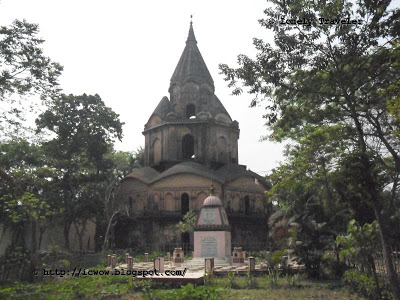
Jagannath Dev Mandir is one of the ancient temples in Comilla district. King of Tripura built it. It was named ‘Moharaja Radha Kishor Manikuo Bahadur’ during the 16th century. The gods Jagannath, Balabhadra and Subhadra were worshiped here. Initially, the statue of gods were at Tripura temple but later it was been shifted here. Wikipedia mentioned this as Saptratna Mandir, where as the travel book writer Mustafiz Mamun has introduced this as Sotero Rotno Mandir (সতের রত্নের মন্দির). There might be a state of confusion regarding the name, but this temple is unique considering the other temples from Bangladesh.
The deities of Jagannath, Balabhadra and Subhadra were originally installed in a temple in Tripura from where they were subsequently shifted to this temple. The terracotta brick work of the temple is in the typical Bengal style of temple architecture. Jagannath Temple is one of the oldest temples of Comilla district. It is located two km East from Comilla town, on East Bibirbazar Road, Comilla. (5km east from Comilla dist.)
This four storied, conical shaped temple is a brick built structure, constructed on a concrete octagonal base-stone. This is the only octagonal based and shaped temple of Bangladesh, and one of its type. External wall of every floor looks like octagons and were ascended like inverted Cone. It is a single spire Temple. I believe there were so many artistic terracotta all over this Mandir , from Top to bottom. I find some of the traditional Bengal design on the outside wall of third floor- a terracotta of flower, leaves and petals. Department of Archaeology renovated outside portions of Ground and first floor. Terracotta of these two floors was ruined.
There is a rumor about this ordinary looking spiritual place. Some believes there are two more floors underground, which is filled by sedimentation from Gumti River over the years. I feel this is a weak and bogus point.
This 16th Century edifice is almost 60 feet tall. There is a tank to the West of Temple premises. That Tank could be as old as the temple. The tank is also sketched in 1863 drawing [a British Library Collecton].
Array
(
[0] => Array
(
[name] => Dhakeshwari National Temple
[post_id] => 1455
[post_link] => http://offroadbangladesh.com/bn/places/dhakeshwari-national-temple/
[thumb_link] => http://offroadbangladesh.com/wp-content/uploads/2015/02/Dhakeshwari-National-Temple-3-300x225.jpg
[post_content] =>
Dhakeshwari National Temple is a Hindu temple in Dhaka city. It is state-owned, giving it the distinction of being Bangladesh's 'National Temple'. The name "Dhakeshwari" means "Goddess of Dhaka". Since the destruction of Ramna Kali Mandir in 1971 by the Pakistan Army during the Bangladesh Liberation War, the Dhakeshwari Temple has assumed status as the most important Hindu place of worship in Bangladesh.
The Dhakeshwari temple was built in the 12th century by Ballal Sen, a king of the Sena dynasty, and many say the city was named after this temple. The current architectural style of the temple cannot be dated to that period because of the numerous repairs, renovations and rebuilding which have taken place over time. It is considered an essential part of Dhaka's cultural heritage. Many researchers said that the temple is also one of the Shakti Peethas, where the jewel from the crown of the Goddess Satihad fallen. Although there is not enough historical context to establish this as a fact, researchers were directed to this site while trying to locate the particular Shakti Peetha. Since ages, the temple has been held in great importance. The original 800-year old statue was taken to Kumartuli, Kolkata, West Bengal, India. There remains the replica of original idol in Dhaka. The temple was further damaged during the Muslim mob attacks of 1989–90.
It is widely believed that the Queen, wife of King Bijoy Sen, went to Langolbond for bathing. While coming back, she gave birth to a son, known to historians as Ballal Sen. After ascending to the throne, Ballal Sen built this temple to glorify his birthplace. Legends say that Ballal Sen once dreamt of the deity covered under the jungle. Ballal Sen uncovered the deity from there and built a temple, named for Dhakeswari. Whatever the legends describe, Hindu religious consider Dhakeswari to be the presiding deity of Dhaka, which is an incarnation or form of Goddess Durga the Adi Shakti . The idol of Durga is called Dhakeswari.
Within the premises of the Dhakeswari there are temples of two types of architecture. The ancient one is of the Poncharotna Goddess Durga’s which lost its actual look after the renovation work. Bradly Bird wrote this at the beginning of this century. The present temple is two hundred years old which was built by an agent of East India Company. Most probably he had renovated the temple. Other than this there are four Shib Temples. According to hearsay, in the 16th century King Mansing built these temples by laying four Shib Lingas there. But this information seems to be unreliable. The fusion of Bangla chowchala and shikor temple is notice in the architecture of Dhakeshawri. Ratan Lal Chakraborti in an article mentioned that “ the structure and architecture of it is like a BuddhistPagoda”. He opined that it was probably a Boddist pagoda which was turned into a Hindu temple later. From this, he assumed that the temple was probably built in the 10th century.
How did Dhakeshari temple look like in the 19th century? Ridoynath Majumder described about the temple. At that time the temple was covered by jungle and in its north the Urdu road went westward towards Pilkhana and at its south west was Mirpur road. At its south there was a wood and Urdu bazaar was at the east.
)
[1] => Array
(
[name] => Dolmancha Mandir
[post_id] => 6431
[post_link] => http://offroadbangladesh.com/bn/places/dolmancha-mandir/
[thumb_link] => http://offroadbangladesh.com/wp-content/uploads/2015/04/dolmanch-mandir-by-invitetobd-300x173.jpg
[post_content] =>
Dolmancha Mandir is located at the place name Dhamsreni about 3 km east from Ulipur sub district of Kurigram district. Now it becomes ruin. This Temple or Mandir is located at the home yard of Braksama Priest who was appointed by (1658-1787) landlord Rani Satyabrati. Here has more some Temple but all of the mare seriously damage by 1897 earth quake.
[This spot needs more detail. If you have more information and photos, please be advised to add in our website. Your name will be published as a Content Contributor]
)
[2] => Array
(
[name] => {:en}Shivbari Temple and Zamindar Bari{:}{:bn}শিববাড়ি মন্দিরও ঠাকুরবাড়ি{:}
[post_id] => 4530
[post_link] => http://offroadbangladesh.com/bn/places/shivbari-temple-and-zamindar-bari/
[thumb_link] => http://offroadbangladesh.com/wp-content/uploads/2015/03/Shivbari-temple-and-Jamindar-Bari-300x250.jpg
[post_content] => {:en}
Shivbari Temple, around a hundred years old, is one of the top historical places in Barisal Division. Every year, in this temple, on 14th of Falguni month, massive celebrations go on for three days with different puja programs and fairs. At the first day of this festival, people conduct a congregated worship in accordance to the Hindu religion.
On the next two days, the colorful carnivals continue by following religious customs and traditions. Although it is primarily a ritual practiced by the Hindu people, both Hindus and Muslims participate in the Fair. There is a Zamindar Bari just near to this temple.
{:}{:bn}
প্রায় শতবর্ষ পুরাতন শিববাড়ি মন্দির বরিশালের ঐতিহাসিক স্থানগুলোর মধ্যে অন্যতম। প্রতি বছর বাংলা ফাল্গুন মাসের ১৪ তারিখ এই মন্দিরে তিনদিন ব্যাপি পূজা ও মেলার বিশাল আয়োজন করা হয়। এই উৎসবের প্রথমদিন হিন্দুধর্ম অনুযায়ী গনপ্রার্থনার আয়োজন করা হয় এবং পরের দুইদিন ধর্মীয় প্রথা অনুযায়ী বিভিন্ন উৎসব চলতে থাকে। হিন্দুধর্মের উৎসব হলেও মুসলিমরাও এই অংশ নিয়ে থাকেন।
{:}
)
[3] => Array
(
[name] => Ghoshal Bari Radha Krishna Temple
[post_id] => 11789
[post_link] => http://offroadbangladesh.com/bn/places/ghoshal-bari-radha-krishna-temple/
[thumb_link] => http://offroadbangladesh.com/wp-content/uploads/2015/07/IMG_20150527_142310676_HDR1-300x169.jpg
[post_content] =>
Ghoshal Bari Radha Krishna Temple, About 100 years old (now rebuilt) Radha-Krisna temple with its outstanding view standing at Atpara village. The temple is situated at Atpara under Vajrayoguni Union Parisad of Munshiganj district by the road side leading to Tangibari at a distance of 7.2 km from Munshiganj town. Adjacent to this temple there are two more temples which appear to have been erected recently. It is a ‘Pancha ratna’ temple resting on a square sanctum. Its south-east corner ratna along with large portion of the body is missing. The four turrets are set on the roof top corners while the large fifth central sikhara rises above them the wall of the temple is 63 cm thick. The temple has sharply curved cornices and an arched entrance on the south but its lower portion is in a dilapidated condition. The char Chala central ratna rests upon its rectangular base which has an arched entrance and panel decoration. The south and other sides are relieved with imitation doorway design and paneled bands. The central tapering tower rises above and terminates in an iron shike. The four miniature corner turrets are similar to the central one and have four openings each.This variety is the most popular type of temples that flourished in Bengal in the 19th century A.D.
)
)