Array
(
[0] => Array
(
[name] => Kusumba Mosque
[post_id] => 3656
[post_link] => http://offroadbangladesh.com/places/kusumba-mosque/
[thumb_link] => http://offroadbangladesh.com/wp-content/uploads/2015/02/84463426-300x199.jpg
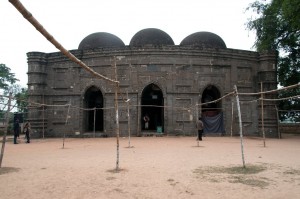
[post_content] => Kusumba Mosque is named after the village of Kusumba, under the Manda upazila of Naogaon district, on the west bank of the Atrai River. It is inside a walled enclosure with a monumental gateway that has standing spaces for guards. It was built during the period of Afghan rule in Bengal under one of the last Suri rulers Ghiyasuddin Bahadur Shah, by one Suleiman who was probably a high ranking official. The inscription tablet in Arabic (only the word ‘built by’ is in Persian) dating the building to 966 AH (1558-59 AD) is fixed over its eastern central entrance.
Although built during Suri rule, it is not influenced at all by the earlier Suri architecture of North India, and is well grounded in the Bengal style. The brick building, gently curved cornice, and the engaged octagonal corner towers are typical features. The mosque, presently protected by the Department of Archaeology of Bangladesh, was badly damaged during the earthquake of 1897. Although the main fabric of the building is of brick the entire exterior walls, and the interior up to the arches of the pendentives have stone facing. The columns, platform, floor, and perforated side screens are of stone. The mosque has a rectangular plan with three bays and two aisles, three entrances on the east and two each on the north and south sides.
The central mihrab is projected in the west. The interior west (qibla) wall has two mihrabs on the floor level opposite the central and southeastern entrances, but the one in the northwestern bay is above a raised platform ascended by a staircase on the east. The presence of such a platform in a non-imperial mosque indicates that not only royalty, but nobility and high-ranking officials were also separated from the general public during prayers. The mihrabs have elaborate stone carving. They have cusped arches crowned with kalasa (water pot) motifs, supported on intricately carved stone pillars which have projections and tasseled decorations hanging from chains. Bunches of grapes and vines curve in an almost serpentine manner on the mihrab frames, and kalasas, tendrils and rosettes are reduced to dots.
The platform edge has grape vine decoration, and there are rosettes on the spandrels of the arches supporting the platform, as well as on the mihrab wall. The stone used in the exterior facing is of a coarse quality and carved in shallow relief. Mouldings are most prominent decorative feature on the outside. They divide the walls into upper and lower sections, run all along the curved cornice, around the corner towers, in a straight line below the cornice, and frame the rectangular panels in the east, south and north walls. The spandrels of the central entrance arch are filled with small kalasa and rosette motifs. The north and south sides have screened windows.
)
[1] => Array
(
[name] => Dayarampur Rajbari
[post_id] => 17288
[post_link] => http://offroadbangladesh.com/places/dayarampur-rajbari-2/
[thumb_link] => http://offroadbangladesh.com/wp-content/uploads/2015/08/Dayarampur-Rajbari18-300x225.jpg
[post_content] =>
Dayarampur Rajbari (দয়ারামপুর রাজবাড়ি) is located in Bagatipara Upazila, inside of the Qadirabad Cantonment under the administration of Bangladesh Army. After taking the oath of the Zamindari, Pramadanath (প্রমদানাথ) Roy (1873-1925), the elder son of then Dighapatia King Promothonath (প্রমথনাথ) Roy (1849-1883), established the Junior Raj Dayarampur Estate in a place named Nondikuza (নন্দীকুজা) on the bank of river Boral and built this Rajbari for his three younger brothers. They are Kumar Bosontokumar Roy (1874-1925), Kumar Sharatkumar Roy (1876-1946) and Kumar Hemendrakumar Roy (1877-1943).
This place was named after Dayaram (দয়ারাম) Roy (1680-1760), the great efficient Dewan of Queen Bhabani (1716-1795) of Natore and the establisher of Dighapatia Royal Family. After the death of Kumar Bosontokumar Roy, Kumar Sharatkumar Roy took the responsibility of the whole Dayarampur Estate and stayed this palace till death. After the eradication of Zamindar dominion, they went to India.
Source: History of Natore, by Samar Pal
)
[2] => Array
(
[name] => {:en}Boktnagar Zamindar Bari and Mosque{:}{:bn}বক্তনগর জমিদার বাড়ী ও মসজিদ{:}
[post_id] => 5541
[post_link] => http://offroadbangladesh.com/places/boktnagar-zamindar-bari-and-mosque/
[thumb_link] => http://offroadbangladesh.com/wp-content/uploads/2015/03/boktonogor-jomidar-bari-bandura-11-300x225.jpg
[post_content] => {:en}
Beside the bank of the Ichhamoti river (ইছামতি নদী), you'll find an old house that is currently abandoned. No inscription was found about the house. From the architecture of the old house, you can only guess that it was a house of a wealthy man who could have been a Zamindar (জমিদার) or a rich merchant. Boktnogor/Boktonogor(বকতনগর/বক্তনগর) is a place located near the Shikari Para(শিকারী পারা) after Bandura bazaar(বান্দুরা বাজার).
This well-built edifice has lot of rooms inside. Front side of the house is still firm, but damaged at the back sides. Still now a days the house has a lot of open spaces around including ponds. At the south-west corner of the mansion, another edifice is available. This one is an old mosque. Again it is unsure about the builder of the mosque.
If the owner of the mosque and the house is the same person, then the owner must be a Muslim. The village name is Boktnagar (বক্তনগর) which should came from Bokht Nogor (বখত নগর). Possibly someone lived there named Bokht (বখত) and sounds a Muslim name, but all are predictions.
The mosque is a small one having three domes at the top. Middle one is a bit larger compare to other twos. Just above the main gate, and inscription is found written in Arabic. The mosque has a pond at the southern side and a graveyard at the eastern side.
{:}{:bn}
ইছামতি নদীর তীরে একটি পরিত্যাক্ত ভবন দেখতে পাবেন তবে কোন শিলালিপি না থাকায় এই ভবনটি সম্পর্কে বিস্তারিত জানা যায়নি। তবে, ভবনের স্থাপত্যশৈলী দেখে বোঝা যায় এটি ছিল একটি জমিদার বাড়ি। এই ভবনটির অভ্যন্তরে বেশকয়েকটি কক্ষ রয়েছে। জমিদারবাড়ির সামনের দিকটি এখনও মজবুত থাকলেও পেছনের দিকটি বেশ ক্ষতিগ্রস্থ হয়েছে।
এখনও ভবনটির চারপাশে একটি পুকুরসহ বেশকিছু খালি জায়গা রয়েছে। জমিদারবাড়ির দক্ষিন-পশ্চিম কোনায় একটি প্রাচীন মসজিদ রয়েছে। মসজিদটির নির্মাণের ব্যাপারেও কিছু জানা যায়নি। যদি জমিদারবাড়ি এবং মসজিদের মালিক একই ব্যাক্তি হয়ে থাকেন তবে ধরে নেওয়া যায় যে তিনি ছিলেন একজন মুসলিম। ধারনা করা হয়ে থাকে যে গ্রামতির নাম বক্তনগর হয়েছে বখতনগর শব্দ থেকে। এমনও হতে পারে যে, বখত নামক কোন মুসলিম ব্যাক্তির নামে গ্রামটির নামকরণ করা হয়েছে।
এখানে অবস্থিত মসজিদটি ছোট এবং তিনগম্বুজ বিশিষ্ট। তবে মাঝখানের গম্বুজটি অন্য দুটি গম্বুজের চেয়ে বড়। মসজিদের মূল প্রবেশ পথের উপরে আরবীতে লেখা শিলালিপি দেখা যায়। মসজিদের দক্ষিনে একটি পুকুর এবং পূর্বদিকে একটি কবরস্থান রয়েছে।
{:}
)
[3] => Array
(
[name] => Bhawal Rajbari
[post_id] => 2973
[post_link] => http://offroadbangladesh.com/places/bhawal-rajbari/
[thumb_link] => http://offroadbangladesh.com/wp-content/uploads/2015/02/vawal-rajbari-gazipur-21-300x225.jpg
[post_content] =>
Bhawal Estate was a large zamindari estate in Bengal in modern-day Bangladesh. The area under the estate currently falls under the Gazipur District. The most famous capital of the Bhawal Estate was Choira Meah Bari, where zamindar Fazal Gazi lived. He was one of the Baro-Bhuyans (12th zamindars of Bengal).
Before the Mughal conquest, Bhawal Estate belonged to Gazis of Bhawal. The first known Gazi was Fazal Gazi, who lent a cannon to Sher Shah Suri with 'Az Fazal Gazi' inscribed on it. The Rajas of Bhawal came from the village of Bajrayogini under Munshiganj. His family ruled Bhawal until the abolition of the zamindari system in 1951 at Choira Meah Bari, which was the capital of Bhawal.
)
)