Array
(
[0] => Array
(
[name] => {:en}Boktnagar Zamindar Bari and Mosque{:}{:bn}বক্তনগর জমিদার বাড়ী ও মসজিদ{:}
[post_id] => 5541
[post_link] => http://offroadbangladesh.com/bn/places/boktnagar-zamindar-bari-and-mosque/
[thumb_link] => http://offroadbangladesh.com/wp-content/uploads/2015/03/boktonogor-jomidar-bari-bandura-11-300x225.jpg
[post_content] => {:en}
Beside the bank of the Ichhamoti river (ইছামতি নদী), you'll find an old house that is currently abandoned. No inscription was found about the house. From the architecture of the old house, you can only guess that it was a house of a wealthy man who could have been a Zamindar (জমিদার) or a rich merchant. Boktnogor/Boktonogor(বকতনগর/বক্তনগর) is a place located near the Shikari Para(শিকারী পারা) after Bandura bazaar(বান্দুরা বাজার).
This well-built edifice has lot of rooms inside. Front side of the house is still firm, but damaged at the back sides. Still now a days the house has a lot of open spaces around including ponds. At the south-west corner of the mansion, another edifice is available. This one is an old mosque. Again it is unsure about the builder of the mosque.
If the owner of the mosque and the house is the same person, then the owner must be a Muslim. The village name is Boktnagar (বক্তনগর) which should came from Bokht Nogor (বখত নগর). Possibly someone lived there named Bokht (বখত) and sounds a Muslim name, but all are predictions.
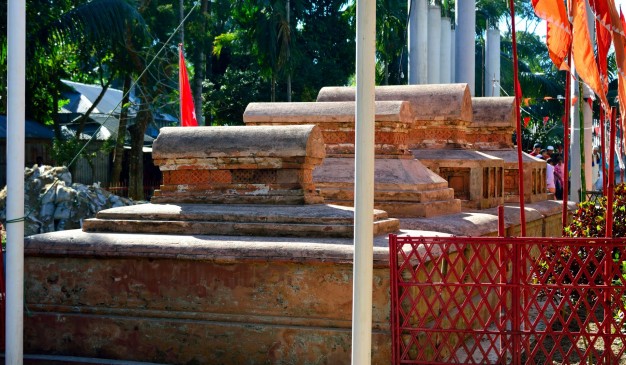
The mosque is a small one having three domes at the top. Middle one is a bit larger compare to other twos. Just above the main gate, and inscription is found written in Arabic. The mosque has a pond at the southern side and a graveyard at the eastern side.
{:}{:bn}
ইছামতি নদীর তীরে একটি পরিত্যাক্ত ভবন দেখতে পাবেন তবে কোন শিলালিপি না থাকায় এই ভবনটি সম্পর্কে বিস্তারিত জানা যায়নি। তবে, ভবনের স্থাপত্যশৈলী দেখে বোঝা যায় এটি ছিল একটি জমিদার বাড়ি। এই ভবনটির অভ্যন্তরে বেশকয়েকটি কক্ষ রয়েছে। জমিদারবাড়ির সামনের দিকটি এখনও মজবুত থাকলেও পেছনের দিকটি বেশ ক্ষতিগ্রস্থ হয়েছে।
এখনও ভবনটির চারপাশে একটি পুকুরসহ বেশকিছু খালি জায়গা রয়েছে। জমিদারবাড়ির দক্ষিন-পশ্চিম কোনায় একটি প্রাচীন মসজিদ রয়েছে। মসজিদটির নির্মাণের ব্যাপারেও কিছু জানা যায়নি। যদি জমিদারবাড়ি এবং মসজিদের মালিক একই ব্যাক্তি হয়ে থাকেন তবে ধরে নেওয়া যায় যে তিনি ছিলেন একজন মুসলিম। ধারনা করা হয়ে থাকে যে গ্রামতির নাম বক্তনগর হয়েছে বখতনগর শব্দ থেকে। এমনও হতে পারে যে, বখত নামক কোন মুসলিম ব্যাক্তির নামে গ্রামটির নামকরণ করা হয়েছে।
এখানে অবস্থিত মসজিদটি ছোট এবং তিনগম্বুজ বিশিষ্ট। তবে মাঝখানের গম্বুজটি অন্য দুটি গম্বুজের চেয়ে বড়। মসজিদের মূল প্রবেশ পথের উপরে আরবীতে লেখা শিলালিপি দেখা যায়। মসজিদের দক্ষিনে একটি পুকুর এবং পূর্বদিকে একটি কবরস্থান রয়েছে।
{:}
)
[1] => Array
(
[name] => Goaldi Mosque
[post_id] => 10965
[post_link] => http://offroadbangladesh.com/bn/places/goaldi-mosque/
[thumb_link] => http://offroadbangladesh.com/wp-content/uploads/2015/07/DSC068591-300x225.jpg
[post_content] =>
Sonargaon contains quite a number of Archaeological evidences, helping the scholars to reconstruct the Medieval History of Sonargaon area of Bangladesh. Goaldi Mosque, one of the very few surviving medieval monuments in the city of Sonargaon. About 6 km north-west of the little township of Panam, near Sonargaon in Narayanganj district, there are two such precariously surviving old single-domed mosques in the sequestered hamlet of Goaldi, virtually hidden behind thick bamboo brakes and clusters of mango and jackfruit tree groves.
Built in 1519, the graceful, single-domed Goaldi Mosque is the most impressive of the few extant monuments of the old capital city, and a good example of pre-Mughal architecture. This mosque is one of the few remnants from the Sultanate period in Sonargaon, during the reign of Sultan Hussain Shah in 925 Hijri (1519 AD). It was built by Mulla Hizabar Akbar Khan in the early 16th century, during the reign of Alauddin Husain Shah at a place called Goaldi - half a mile northeast of Panam village in Sonargaon. Sonargaon was the administrative center of medieval Muslim rulers of East Bengal. It became as the capital of Bengal during Isa Khan's ruling. The area falls under present-day Narayanganj District, Bangladesh. This mosque is more elegant and ornate in comparison to the earlier Sultanate mosques at Bagerhat.
There are some ornamental black stone pillars inside the prayer hall for the support of the roof. Corresponding to the three arched doorways on the east there are three richly decorated mihrabs on the west wall, of which the central one is bigger and beautifully embellished with curved floral and arabesque relief on dark black stone, but the flanking side mihrabs are ornamented with delicate terracotta floral and geometric patterns. The central stone mihrab is framed within an arched panel with an expanded sunflower motif in the centre. Below that the spandrels of the multi-cusped arch of the mihrab are decorated within a rectangular frame. The engrailed arched recess is carried on stunted octagonal pillars faceted at stages. Four round-banded turrets at the outer corners rise up to the curvilinear cornice.
)
[2] => Array
(
[name] => {:en}Washil Chowdhury Para Mosque{:}{:bn}ওয়াশিল চৌধুরীপাড়া মসজিদ{:}
[post_id] => 8035
[post_link] => http://offroadbangladesh.com/bn/places/washil-chowdhury-para-mosque/
[thumb_link] => http://offroadbangladesh.com/wp-content/uploads/2015/05/Washil-Chowdhury-Para-Mosque-300x201.jpg
[post_content] => {:en}
Washil Chowdhury Para Mosque is a historical mosque in Chittagong City. It was established in 1795 by landlord Asgar Ali Chowdhury.
[We need more detail information of this spot. If you have more information and photos, please be advised to add and share in our website. Your name will be published as a Content Contributor]
{:}{:bn}
চট্রগ্রাম শহরের একটি ঐতিহাসিক মসজিদের নাম ওয়াশিল চৌধুরীপাড়া মসজিদ। ১৭৯৫ সালে জমিদার আসগার আলী চৌধুরী এই মসজিদটি প্রতিষ্ঠা করেন।
{:}
)
[3] => Array
(
[name] => Khan Mohammad Mridha Mosque
[post_id] => 7286
[post_link] => http://offroadbangladesh.com/bn/places/khan-mohammad-mridha-mosque/
[thumb_link] => http://offroadbangladesh.com/wp-content/uploads/2015/04/Khan-Mohammad-Mridha-Mosque1-300x225.jpg
[post_content] =>
Khan Mohammad Mridha Mosque is another archaic mosque from our Dhaka city. Unlike other mosques, this one has plenty of spaces around it, and not consumed by the proximity buildings.
The mosque was built over a very high vault like platform. Using the stair, anyone can go to the upper store and able to have the beauty of the antiquity. According to the inscription of the central doorway of the mosque, it was built during 1704–05 AD by someone named Khan Muhammad Mridha, and the mosque was named after him.
The mosque has three domes at the top of it and has four pillars at the four corners with traditional ornate. If you visit the mosque, you may find that the door is closed. It usually opens at the time of the prayer.
At the eastern side of the mosque, there is a tomb exists, but no epigraph over the tomb, so it is hard to find anything further about this. Also the there is a garden available at eastern side having various kind of seasonal flowers.
There are plenty of spaces around the mosque. It will allow you to observe the mosque without any obstacle unlike any other mosques from Dhaka City. Having roads at west and north of the mosque kept it detached from other buildings.
)
)