Brief
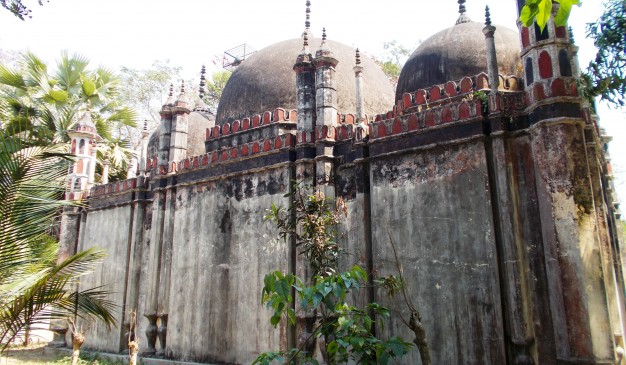
Atkandi Nilkuthi Mosque (আটকান্দি নীলকুঠি মসজিদ ) is situated in the Atkandi village of Raypura upazila, Narsingdi. It was built by a man named ‘Alim Uddin’. Alim Uddin built this Mosque just beside the grave yard of his wife ‘Sadetunnesa’. To build this Mughal stylistic Mosque he brought some masons from far land Mohishur, India. Some even compare it with Tajmahal, given its architectural style and the emotions behind it.
Alim Uddin completed his education on Islamic religion from Deobond and later worked as Teacher in a madrasa, conducted by Khawaza Family in Dhaka. Later in 18th century, he built this Mosque, however the exact date of founding this Mosque could not be determined.
Architectural property and Layout :
It is a rectangular shaped Mosque. Which can be divided into three specific spatial context. We can exemplify it as below-
1. Inner zone
2. Exterior Corridor zone
3. Exterior Porch zone (under open sky)
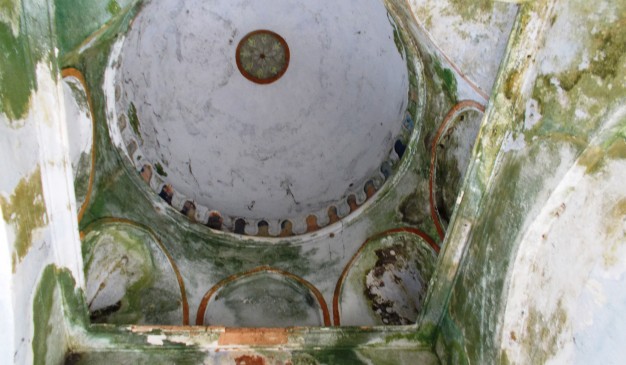
Inner Zone of this Mosque contains three domes, and a Mihrab. Among these, three bulbous domes, among which the middle one is the biggest. The inner zone contains two entrances.
Exterior corridor zone of this mosque is elongated in north-south forming a rectangular shape. It contains five bulbous domes, which is smaller than other three. This zone also contains five entrances which are arch shaped and decorated with multi foiled design. In parapet it’s decorated with the Merlon design. In the base line of outer wall it’s decorated with a pitcher design.
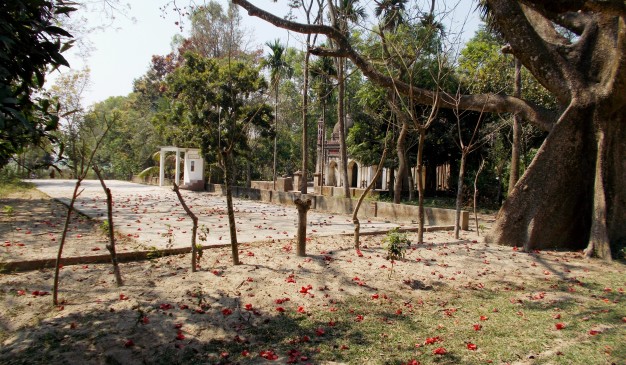
Exterior porch zone of this mosque was built considering the large gathering which take place. It’s a square shaped plastered floor, with one feet high bordered wall all around the porch. It contains a main gateway to enter into the Mosque.
Public gathering in different occasion:
In different kind of public occasions, like in the eve of Eid-festivals and in common vacations people from different parts of the country come here to visit this place. On the southern part of this Mosque there is an old Ghat (in the edge of a river) which has stepped down to the branch of Meghna river. So far we know, it was built by G.P. Wize when this region was a place to plant indigo in a massive scale.
Present Condition and ruins of several unrevealed structure:
Present condition of this Mosque is not so consistent in a sense of building strength. It is in very sensitive condition, where it is randomly being used without any treatment of conservation & preservation. That’s why we can observe some deterioration in the brick building both in Exterior & interior part.
In the northern part of the Mosque there are some ruins of buried structure. Some outer portion of that buried structure is seem like spherical shape. Which demands more exploration and systematic archaeological excavation to reveal the history behind this region.
Where to Stay
1) Circuit House, Narsingdi (Government)
Phone: 02-9462083
Mobile: 01735-840294
2) District Council Postal Bungalow (Government)
Postal Bungalow Road, Narsingdi
Phone: 029463765
Mobile 01712-521274
3) Dak bungalows (Government)
Roads and public departments, Narsingdi
phone: 029463222
4) Rest House (Government)
Civil surgeon’s office, Narsingdi
Phone: 029463181
5) Rest House (Government)
LGED Office, Narsingdi
Phone: 029462260
6) Hotel Nirala
Library parti, Narsingdi market, Narsingdi
Phone: 029463393
Mobile: 01711-196699
7) Hotel Al-Arafat
215/1 siendabi Road, busstation, Narsingdi
Phone: 029463393
Mobile: 01712-130139
8) Hotels Mamataj
Patilbari Road, Narsingdi
Mobile: 01711-952120
9) Hotel Aziz
Patilbari Road, Narsingdi
Mobile: 01712070231
10) Hotel Riyaj
Patilbari Road, Narsingdi
Phone: 946 to 516
Mobile: 01712-609045
11) Hotel Tanim
Patilbari Road, Narsingdi
Phone: 9463982
Mobile: 01718-916143
Array
(
[0] => Array
(
[name] => Khanjan Dighi Mosque
[post_id] => 3604
[post_link] => http://offroadbangladesh.com/bn/places/khanjan-dighi-mosque/
[thumb_link] => http://offroadbangladesh.com/wp-content/uploads/2015/02/Khanjan-dighi-mosque-1-300x225.jpg
[post_content] => Khanjan Dighi Mosque is located at the south of Dasbari mosque, where Ballal Sen excavated a Dighi. Against the southern fringe by going a bit north we can see remnants of Khanjan Dighi mosque. It is also known as Khoniya Dighi mosque to many. Many also know it as Rajbibi Mosque. The mosque has been inside the jungle for a long time. The loss of forest makes the mosque visible to human eye. By seeing its architecture it is assumed that it was built in the 15
th century.
)
[1] => Array
(
[name] => Belabo Bazar Mosque
[post_id] => 7930
[post_link] => http://offroadbangladesh.com/bn/places/belabo-bazar-mosque/
[thumb_link] => http://offroadbangladesh.com/wp-content/uploads/2015/04/241559351-300x225.jpg
[post_content] =>
Belabo Bazar Mosque,a grand mosque constructed with Tk 35 million, was inaugurated on 8th of November 2008. At least 12,000 people can say their prayers at a time at the mosque of 200 feet length and 125 feet width. Renowned industrialist of Narsingdi district Abdul Kadir Mollah carried the whole construction cost of the mosque.
The first founder and land owner of the Moque named 'Alhajj Mahmud Ali Bhuiyan' donated his land for building this Mosque. Who is known as 'Mamdi Bepari'. Later Abdul Kadir Mollah announced his grand donation on a public place in Belabo to build this Mosque as a Mega Structure. Local people feels proud to be the inhabitants of this Upazila. Many people from different direction come to visit this Mosque everyday.
)
[2] => Array
(
[name] => Kismat-Maria Mosque
[post_id] => 9282
[post_link] => http://offroadbangladesh.com/bn/places/kismat-maria-mosque/
[thumb_link] => http://offroadbangladesh.com/wp-content/uploads/2015/05/kismat-maria-mosque-durgapur-rajshahi-12-300x225.jpg
[post_content] =>
Kismat-Maria Mosque (কিসমত-মারিয়া মসজিদ) is the academic name, where local people knows this as Durgapur mosque (দুর্গাপুর মসজিদ). The mosque is located at the Maria (মারিয়া) village, adjacent to village Kismat (কিসমত), that's why it is called Kismat-Maria Masjid.
It is totally unknown about any sort of historical information. No inscription available at the doorway or anywhere. Even the government doesn't have any document or info regarding this. To add insult to the injury, the local people cannot remember anything about this mosque either. It’s a total mystery.
It is certain that the mosque was built several hundred years back. It is having three domes at the top. Four ornate pillars at the four sides of the mosque. Eastern side of the mosque is having three entrances. The mosque is built over a 2-3 feet of high base. The domes of the mosque is similar to the Kartalab Khan's Mosque at Old Dhaka.
The mosque has a small house type of building at the southern side. This is another great archaeological object from our Bangladesh.
)
[3] => Array
(
[name] => Walipur Alamgiri Mosque
[post_id] => 5153
[post_link] => http://offroadbangladesh.com/bn/places/walipur-alamgiri-mosque/
[thumb_link] => http://offroadbangladesh.com/wp-content/uploads/2015/03/WalipurAlamgiriMosque-300x214.jpg
[post_content] =>
Walipur Alamgiri Mosque is situated in Walipur village under Hajiganj Upazila of Chandpur district. There are two mosques in the same locality - one known as Shahi Alamgiri Mosque and the other as Shah Shuja Mosque. The Alamgiri mosque has suffered much due to subsequent restoration works. Nevertheless, enough still survives to give an idea of its original plan and design. A Persian inscription in fine nastaliq character, fixed over the central doorway, records the construction of the mosque by one Abdullah in 1692 AD in the reign of Alamgir Aurangzeb.
In the middle of the eastern facade of the oblong mosque (15.24 m by 8.23 m) there is a projected fronton bordered with octagonal turrets through which opens out the main doorway. This has a higher arch with a half-dome within a rectangular frame. There are two more doorways in the eastern facade, one on either side of the central opening, having an outer arch with a half-dome below. Each of the north and south walls is pierced with a pair of arched doorways. The mosque has therefore seven archways in total -three in the east and two on each of the north and south walls. The four exterior angles of the building are strengthened by octagonal towers, which are carried beyond the horizontal parapets and topped over with kalasa finials, but have now been renovated.
Two massive octagonal brick pillars divide the interior of the mosque into five square bays - a large one in the middle (5.87m a side) and two smaller ones on its either side which are arranged in the east-west axis. Archways interconnect the bays; the arches are placed directly on two free standing octagonal pillars and engaged semi-octagonal pillars. It is worth noting that these arches are continued upwards as walls to make the bays above. This special device has given the mosque a two-storied appearance internally. All the five bays are roofed over with domes crowned with lotus and kalasa finials on cylindrical drums. The domes are carried on half-domed squinches on the upper corners and the blocked arches in between the square inches in the middle of the walls.
Octagonal turrets rising high above the horizontal parapets border the outside projection of the central mihrab, like that of the central archway. Inside, there are three mihrabs in the qibla wall. The central mihrab is semi-octagonal in design, but the flanking mihrabs are of the shallow rectangular type.
The original plastering of the building has been replaced by modern cement plaster. The horizontal parapet is now plain. The facade of the central archway projection is marked with shallow rectangular panels, each being further enriched with such motifs as plants and small trees with flowers in stucco. The central mihrab arch springs from beautifully decorated pilasters and has foliaged designs at its spandrels. The rectangular frame of the central mihrab, though now barely plain, is topped over with a frieze of blind merlons. A fine specimen of Mughal stucco ornamentation is still preserved in the squinches and blocked arches in between, which support the domes above. The extrados of the squinch arches and blocked arches are ornamented with interlocking scrolls, while the tympanums of the blocked arches are minutely embellished with floral scrolls with intertwining rosettes in the centers. Above them all round the interior base of the cylindrical drum runs a slightly sunken frieze decorated with floral scrolls.
Five-domed type mosque, one of the important varieties of Bengal mosques, shows two sub-types: (a) a mosque with a large central dome and a pair of small domes on each side in the same line and (b) a mosque with a large central dome and four small domes on the corners. The present mosque is the culminating example of the second variety. Both in planning and in the execution of elevation details of the building, the architect and the artisans have left behind a clear mark of their skills and perfection of ideas. The division of the interior of the mosque into five squares has been very scientifically effected by the disposition of two octagonal short massive freestanding pillars instead of the two east-west wide arches of the previous examples of the series. Mosques on this model were not built in Bengal for a long time, but almost two centuries later the type reappeared in the Becharam Dewri Mosque (1872) in the city of Dhaka. In plan Becharam Dewri Mosque is an exact copy of the Alamgiri Mosque but inferior in quality and elevation details.
Such mosque design in Bengal started with austagram mosque and evolved through the sarail mosque and the Walipur Alamgiri Mosque. The design is really unique. Question may now arise as to the origin of this particular kind of Bengal mosques. In Turkey under the early Ottomans the mosque of Rustam Celebi (c first half of the 15th century) at Tokat provides perhaps the earliest known example of its kind with five domes - the large central one and a small one on four corners. Similar plan is also found in such other Ottoman mosques as the Guzelce Hasan Bey Mosque (1406) in Hayrabolu and the Uc Serefeli Cam (1437-47) at Edirne. These mosques are generally regarded as the precursors of the great Ottoman mosques at Istambul - Bayezid mosque (1501-06), Sulaymaniya Mosque (1550-59), and the beautiful Selimya Mosque (1569-75) at Edirne. The five-roomed or five-domed planning of the Ottoman mosques may perhaps be said to have been dictated by those of some early Muslim buildings of Syria.
In India the Jamat Khana Mosque (1310-16) at Delhi is a lone example of its kind. This mosque design continued to have been practiced in Northern India in an elaborated form in Humayun's Mosque (1530) at Agra, where four small domed-rooms, instead of two, are attached on either side of the large central domed chamber. It may, therefore, be said that the plan of the second variety of the five-domed type mosques in Bengal was not innovated by Bengal architects, and its idea is very likely to have been borrowed from the sources stated above, particularly perhaps from those of Turkey or Upper India.
Written by: MA Bari
)
)