Array
(
[0] => Array
(
[name] => Ulpur Zamindar Bari
[post_id] => 18413
[post_link] => http://offroadbangladesh.com/bn/places/ulpur-zamindar-bari/
[thumb_link] => http://offroadbangladesh.com/wp-content/uploads/2015/09/Ulpur-Jomidarbari-1-300x169.jpg
[post_content] =>
During 1850, the greater Gopalganj area was ruled by the Zamindar. At that time, they made hundreds of buildings for their residence and official purposes. The buildings were made in the traditional Zamindar Bari look and style. In the last 150 years, most of the houses were destroyed by erosion. After being taken by the government, the authority turned some of these houses into government buildings. Now, most of the houses are abandoned or occupied by local people.
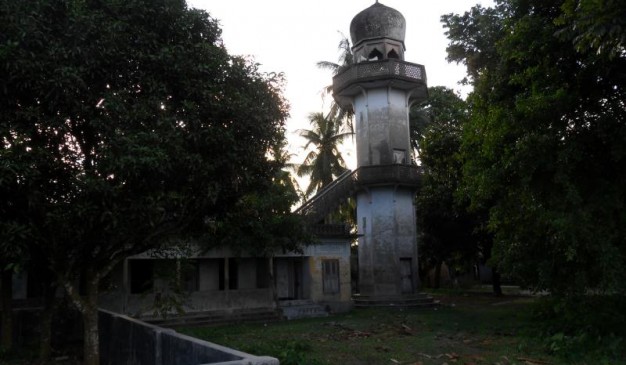
There is a cluster of old buildings in the Ulpur Area which is situated in the Gopalgonj - Takerhat highway, not so far from the Gopalgonj main town. As soon as you cross the Ulpur bridge from Ulpur bazar, the buildings start to appear. The first one was used as the Union Land Office (Government) but is now abandoned. The local people over there are now using it to stock fodder.
The second was probably used as a duplex residential complex but now is being used as the Sub Post Office. The surrounding environment is good and the building is covered by bamboo stocks. In the main road, there is a large old building, which was probably the main building. Outside this building the words "Dinesh Dham" in Bengali is carved in a white slate. This building is currently occupied by some local inhabitants.
If we go farther, then we will see another broken house formerly used as the Upazilla Registry office, now almost completely in ruins. "Din-Dham" in Bengali is also carved outside he building in white stone.
The overall environment of this village is very good and peaceful. Walking for an hour in the silence of this area will be relaxing. The most attractive structure is the Temple. The walls of the temple is decorated with colorful glass & ceramics. The temple looks good but it is also abandoned so the temple has shifted into a newly constructed building.
)
[1] => Array
(
[name] => {:en}Natore Rajbari{:}{:bn}নাটোর রাজবাড়ি{:}
[post_id] => 3706
[post_link] => http://offroadbangladesh.com/bn/places/natore-rajbari/
[thumb_link] => http://offroadbangladesh.com/wp-content/uploads/2015/02/IMG_20150723_053634-300x225.jpg
[post_content] => {:en}
Natore Rajbari (also known as Pagla Raja's Palace, Natore Palace) was a prominent royal palace in Natore, Bangladesh. It was the residence and seat of the Rajshahi Raj family of Zamindars. Famous queen Rani Bhabani lived here and after the death of her husband, expanded both the estate and the palace.
Natore Zamindars was one of the largest Zamindaris of Bengal. The originators of this Zamindari were Ramjivan and Raghunandan both sons of Kamdev. Ramjivan's daughter-in-law was Rani Bhabani (1716-1795), a legendary name in Bengal politics in the 18th century and an endearing personality in every home of the country due to her boundless generosity and public spirit. After becoming Zamindar Ramjivan built his Rajbari at Natore occupying a huge area of 50.42 acres of land and it is enclosed within two rings of defensive moats-one within the other. The moats are now dotted with large tanks, orchards and flower gardens surrounding the derelict ruins of the seven surviving detached palaces. Of these only four deserve description while the rest are in advanced stage of disintegration and are of no architectural significance.
After the death of the great queen, her adopted son Ramkrishna ruled the area. After his death, his two sons Sibnath and Vishwanath became the co-sharers of the Natore Zamindari in 1778. The whole Zamindari was divided between them, and the part of the eldest son was known as "Boro Taraf" and the part of the youngest son was known as "Chhoto Taraf". The Rajbari was protected on all sides by ditches. There were nine buildings in this Rajbari. They are the palace of Boro Taraf, The palace of Choto Taraf, Kachari Bhavan and Guard House of Boro taraf, Kachari Bhavan of Choto Taraf, Rani Bhavan, Guest House, Madhu Rani Bhavan etc.
The main palace block (Boro Torof), now housing the newly created deputy commissioner's office, faces a large open lawn to the south. Two other single-storied blocks, placed on the west and the south, look over the lawn and are laid out in the form of an English "U" with the open side on the east. The main northern block, facing south, has a frontage of about 100'-0" with a prominently projecting porch in the middle and two slightly projecting bays at either end, all carrying triangular pediments above. The elegant central porch is supported on a series of Corinthian columns and semi-circular arches in the typical classical Roman style and the veranda in front of the apartments are also similarly relieved. The whole facade is tastefully decorated with geometric and floral panels in plasterwork. This block contains twelve spacious apartments, disposed on either side of the large reception hall (7.47m × 16.01m) which is located in the middle. The access to the reception hall (60'-0"x 30'-0") is gained through another large hall and is backed by a 10'-0" wide veranda on the north.
The lofty ceiling of the central hall, rises to a height of 30'-0" and is lit by eighteen clerestory windows, originally fitted with colored glass panes, whilst the roof of the other rooms are considerably lower in height. The entire floor of this block is laid in black and white imported marble. The back veranda is supported on twenty pairs of Corinthian columns, the capitals of which contain within its acanthus leaves, some classical nude female figures. The western block, placed at right angles to the main block, has about a 200'-0" frontage and faces the lawn on the east. It is also a single-storied building with an arched projecting bay in the middle. A strip of veranda, supported on a series of paired Doric columns, runs the entire length of the block. Entering through the arched central bay there is access into an open of longed court, occupied by typical 'nat-mandap'. Beyond and further to the west, is a Krishna temple. This family shrine has a 50’-0” wide frontage, backed by a 10’-0” wide veranda which carried on a series of double Corinthian columns.
This ‘nat-mandap’ has a humped tin roof supported on a series of iron pillars. Placed at right angles to this block is another north facing single-storied building, which is about 150’-0” long and has central projecting porch. The porch entrance leads on to a long veranda running the entire length of the building behind which there are a series of apartments of varying sizes, somewhat similarly disposed as the former. A long veranda to the rear of this building overlooks a large tank. A series of Corinthian columns, which support veranda, projects as a semi-circle in the middle. The rear of this handsome block is tastefully decorated in plasterwork. The building at present is occupied by the office of the superintendent of police.
To the south-west rears of the second block a couple of very ruined single-storied residential buildings overlook a large tank from its northern bank. The smaller of these two structures presenting a 50’-0” frontage with a veranda, is relieved with a series of paired Doric columns while the larger adjacent block has a 100’-0” frontage with a veranda carried on a row of double Corinthian columns. Sadly both these ruins are now thickly covered with encroaching thickets and accumulating debris. However, the main palace block of the ‘Chhota-Taraf’, perched picturesquely on the western bank of this large tank and now occupied by the District Judge’s Court, is an imposing structure. The 70’-0” long façade has a prominently projecting central triple-arched portico.
The central part of the building, occupied by the reception hall projects above the flanking wings and is crowned by a pyramidal roof with clerestory windows. The parapet of the porch is decorated in plasterwork with two short projecting bays at either end of the building, each decorated with two pairs of Corinthian columns, which are topped by triangular pediments. Entering this palace block though the porch one encounters a long 10’-0” wide veranda with a black and white marble floor. Behind the veranda there is a row of apartments which lead on to the vast reception hall, measuring 7.32 meter x 15.55meter.
The lofty ceiling of reception hall is another hall measuring 50’-0”x20’-0” with a projecting balcony at the far end which overlooks the encircling moat. Although there are fifteen apartments including the central hall. The rear of the building also is tastefully relieved with Ionic capitals, floral motifs and bearded human heads in stucco. The two large halls of the palace, probably flagged in marble, are now devoid of their original floor, but the other apartments have white and black marble floors. Curiously the capitals most of the columns are of composite character with acanthus leaves intertwining Ionic roundels.
{:}{:bn}
নাটোর রাজবাড়ি পাগলা রাজার প্রাসাদ বলেও বহুল পরিচিত যেটি রাজ জমিদার পরিবারের বাসস্থান হিসেবে ব্যাবহার করা হত। রানী ভবানী এখানে বাস করতেন এবং মৃত্যুর পর তাঁর স্বামী এখানকার চা বাগান ও প্রাসাদের উন্নয়ন করেন। সাতটি আলাদা প্রাসাদের পরিত্যাক্ত ধ্বংসাবশেষ ঘিরে থাকা পরিখাগুলোতে এখন দেখা যায় ট্যাংক, অর্কিড এবং ফুলের বাগান। এই প্রাসাদগুলোর মধ্যে মাত্র চারটি এখন টিকে আছে কিন্তু বাকিগুলো ধ্বংসের দ্বারপ্রান্তে। রানীর মৃত্যুর পর তাঁর দত্তক পুত্র রামকৃষ্ণ এই এলাকা শাসন করেন। রামকৃষ্ণের মৃত্যুর পর তাঁর দুই পুত্র শিবনাথ এবং বিশ্বনাথ নাটোর জমিদারবাড়ির যৌথ মালিক হন ১৭৭৮ সালে। পুরো জমিদার বাড়ি তাদের তাঁদের মধ্যে ভাগ করে দেওয়া হয়। এরপর রাজবাড়িতে বড় পুত্রের অংশকে বলা হত “বড় তরফ” এবং ছোট পুত্রের অংশকে বলা হত “ছোট তরফ”।
রানী ভবানীর বড় পুত্র বড় তরফ নামে এবং ছোট পুত্র ছোট তরফ নামে পরিচিত ছিলেন। রানীর মৃত্যুর পর তাঁর দুই পুত্রের মধ্যে জমিদারী ভাগ হয়ে যায়। এখানে অনেক স্মৃতি স্তম্ভ আছে।
বাংলার অন্যতম বৃহত্তম জমিদারী ছিল নাটোরের জমিদারী। এই জমিদারীর সূচনা করেছিলেন কামদেবের দুই পুত্র রামজীবন এবং রঘুনন্দন। রামজীবনের পুত্রবধু ছিলেন রানী ভবানী। ১৮শ শতকে বাংলার রাজনীতিতে রানী ভবানী ছিলেন এক কিংবদন্তি। তাঁর জনপ্রিয়তা ও উদারতার কারনে দেশের প্রতিটি ঘরে তিনি আকর্ষণীয় ব্যাক্তিত্তে পরিণত হয়েছিলেন। জমিদার হবার পর রামজীবন ৫০.৪২ একর জায়গার ওপর দুই স্তরের পরিখার মধ্যে এই রাজবাড়িটি নির্মাণ করেন।
রাজবাড়িটির চতুর্দিক পরিখার মাধ্যমে সুরক্ষিত ছিল। রাজবাড়িতে নয়টি ভবন ছিল যেমনঃ বড় তরফের প্রাসাদ, ছোট তরফের প্রাসাদ, বড় তরফের কাচারি ভবন ও প্রহরী কক্ষ, ছোট তরফের কাচারি ভবন, রানী ভবন, অতিথিশালা, মধু রানী ভবন ইত্যাদি। ছোট তরফের প্রাসাদটি ১৯৮৪ সালে নাটোরের জজ কোর্ট হিসেবে ব্যাবহার করা হয়েছে। এখানে বেশ কিছু পুকুর আছে যার মধ্যে একটি ছিল ছোট তরফের এবং আরেকটি বড় তরফের।এখানে রানীমহল নামে একটি পরিত্যাক্ত প্রাসাদ আছে যেখানে রানী বাস করতেন।
{:}
)
[2] => Array
(
[name] => Teota Zamindar Palace
[post_id] => 13757
[post_link] => http://offroadbangladesh.com/bn/places/teota-zamindar-palace/
[thumb_link] => http://offroadbangladesh.com/wp-content/uploads/2015/08/Teota-Zamindar-Palace-2-300x225.jpg
[post_content] =>
Teota Zamindar Palace (তেওতা জমিদার বাড়ী) is located at the Shibalaya (শিবালায়া) Upazila of Manikganj District. This palace is locally known as Teota Rajbari (তেওতা রাজবাড়ি) and Teota Zamindar Bari (তেওতা জমিদার বাড়ী). This palace is possibly over 300 years old. This old dilapidated palace was the home of two brothers named Babu Hemsankar Ray ( বাবু হেমসংকর রায়) and Babu Joy Sankar Ray (বাবু জয় সংকর রায়) who were the ruler of Teota. The whole premise has over 50 rooms. Currently those are occupied by the homeless people.
At the Western side of the building, there is a large pond and beside the pond a temple is located named as Noborotno Temple (নবরত্ন মন্দির). The temple is a four storied building having a glorious example of classical architecture.
The whole palace is situated just beside the bank of mighty river Jamuna. After a few miles from the palace premise, the river merged with another big river, Padma. The palace is a two storied building and from the roof you can easily see the Jamuna river.
This palace is the birth place of Promila Debi (প্রমীলা দেবী), the wife of our national poet Kazi Nazrul Islam (নজরুল ইসলাম). Poet first saw her in this palace when he came here to visit Promila's cousin-Dhiren Sen (ধীরেন সেন).
)
[3] => Array
(
[name] => Horipur Boro Bari
[post_id] => 6569
[post_link] => http://offroadbangladesh.com/bn/places/horipur-boro-bari/
[thumb_link] => http://offroadbangladesh.com/wp-content/uploads/2015/04/Horipur-Boro-Bari-Brahmanbaria-011-300x225.jpg
[post_content] =>
Horipur Boro Bari, also known as Horipur Zamindar Bari is a mammoth mansion that is located at the Horipur village of Nasirnagar Upazila of Brahmanbaria district. This is exactly adjacent to the bank of the river Titash. From outside it’s hard to get any essence of its antiquity and beauty. This is a capacious mansion having plenty of rooms at the both floor.
From the inscription from a Moth near the area it is found that the owner was Zamindar Krishna Prasad Ray Choudhury (জমিদার কৃষ্ণ প্রসাদ রায় চৌধুরী) who built that around 1343 of Bengali Calendar. At the front side it has a Ghat for taking bath (also may be for taking part in a family gossip during after noon).
Right now, the situation of the building is not good. This is now occupied by lot of poor families (Hindu people from their dress up and religious practice). Due to lack of care, most of the walls are decaying. It’s a two stored building and few portion of the second floor is risky. But still people are living at the ground floor.
The mammoth size, stylish architecture, etc simply implies that how sumptuous the owner was. Though most of the parts are diminished but still there is a portion of a Pasha Ghor exists at the second floor. Probably the owner used to play Pasha with his mates. May be it was a dance floor where the rich Baijee (Dictionary: Dancer) used to perform every night.
Since this is exactly beside the river Titash, lot of people use to visit here with a boat as a part of their picnic. As per the local, this type of picnic party uses to visit frequently during the weekends. And still people from Dhaka know very little about this place. You can explore the river after visiting this old Zamindar Bari. But you may not find any boat for hiring around there. Most of those are the private boats. May be you can request them to use for a while. Just about few hundreds meter apart from the building you'll find a cremation place which was built by the same owner.
)
)