Array
(
[0] => Array
(
[name] => Walipur Alamgiri Mosque
[post_id] => 5153
[post_link] => http://offroadbangladesh.com/bn/places/walipur-alamgiri-mosque/
[thumb_link] => http://offroadbangladesh.com/wp-content/uploads/2015/03/WalipurAlamgiriMosque-300x214.jpg
[post_content] =>
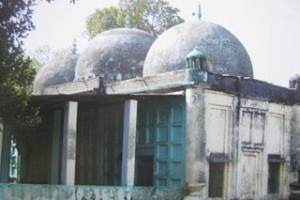
Walipur Alamgiri Mosque is situated in Walipur village under Hajiganj Upazila of Chandpur district. There are two mosques in the same locality - one known as Shahi Alamgiri Mosque and the other as Shah Shuja Mosque. The Alamgiri mosque has suffered much due to subsequent restoration works. Nevertheless, enough still survives to give an idea of its original plan and design. A Persian inscription in fine nastaliq character, fixed over the central doorway, records the construction of the mosque by one Abdullah in 1692 AD in the reign of Alamgir Aurangzeb.
In the middle of the eastern facade of the oblong mosque (15.24 m by 8.23 m) there is a projected fronton bordered with octagonal turrets through which opens out the main doorway. This has a higher arch with a half-dome within a rectangular frame. There are two more doorways in the eastern facade, one on either side of the central opening, having an outer arch with a half-dome below. Each of the north and south walls is pierced with a pair of arched doorways. The mosque has therefore seven archways in total -three in the east and two on each of the north and south walls. The four exterior angles of the building are strengthened by octagonal towers, which are carried beyond the horizontal parapets and topped over with kalasa finials, but have now been renovated.
Two massive octagonal brick pillars divide the interior of the mosque into five square bays - a large one in the middle (5.87m a side) and two smaller ones on its either side which are arranged in the east-west axis. Archways interconnect the bays; the arches are placed directly on two free standing octagonal pillars and engaged semi-octagonal pillars. It is worth noting that these arches are continued upwards as walls to make the bays above. This special device has given the mosque a two-storied appearance internally. All the five bays are roofed over with domes crowned with lotus and kalasa finials on cylindrical drums. The domes are carried on half-domed squinches on the upper corners and the blocked arches in between the square inches in the middle of the walls.
Octagonal turrets rising high above the horizontal parapets border the outside projection of the central mihrab, like that of the central archway. Inside, there are three mihrabs in the qibla wall. The central mihrab is semi-octagonal in design, but the flanking mihrabs are of the shallow rectangular type.
The original plastering of the building has been replaced by modern cement plaster. The horizontal parapet is now plain. The facade of the central archway projection is marked with shallow rectangular panels, each being further enriched with such motifs as plants and small trees with flowers in stucco. The central mihrab arch springs from beautifully decorated pilasters and has foliaged designs at its spandrels. The rectangular frame of the central mihrab, though now barely plain, is topped over with a frieze of blind merlons. A fine specimen of Mughal stucco ornamentation is still preserved in the squinches and blocked arches in between, which support the domes above. The extrados of the squinch arches and blocked arches are ornamented with interlocking scrolls, while the tympanums of the blocked arches are minutely embellished with floral scrolls with intertwining rosettes in the centers. Above them all round the interior base of the cylindrical drum runs a slightly sunken frieze decorated with floral scrolls.
Five-domed type mosque, one of the important varieties of Bengal mosques, shows two sub-types: (a) a mosque with a large central dome and a pair of small domes on each side in the same line and (b) a mosque with a large central dome and four small domes on the corners. The present mosque is the culminating example of the second variety. Both in planning and in the execution of elevation details of the building, the architect and the artisans have left behind a clear mark of their skills and perfection of ideas. The division of the interior of the mosque into five squares has been very scientifically effected by the disposition of two octagonal short massive freestanding pillars instead of the two east-west wide arches of the previous examples of the series. Mosques on this model were not built in Bengal for a long time, but almost two centuries later the type reappeared in the Becharam Dewri Mosque (1872) in the city of Dhaka. In plan Becharam Dewri Mosque is an exact copy of the Alamgiri Mosque but inferior in quality and elevation details.
Such mosque design in Bengal started with austagram mosque and evolved through the sarail mosque and the Walipur Alamgiri Mosque. The design is really unique. Question may now arise as to the origin of this particular kind of Bengal mosques. In Turkey under the early Ottomans the mosque of Rustam Celebi (c first half of the 15th century) at Tokat provides perhaps the earliest known example of its kind with five domes - the large central one and a small one on four corners. Similar plan is also found in such other Ottoman mosques as the Guzelce Hasan Bey Mosque (1406) in Hayrabolu and the Uc Serefeli Cam (1437-47) at Edirne. These mosques are generally regarded as the precursors of the great Ottoman mosques at Istambul - Bayezid mosque (1501-06), Sulaymaniya Mosque (1550-59), and the beautiful Selimya Mosque (1569-75) at Edirne. The five-roomed or five-domed planning of the Ottoman mosques may perhaps be said to have been dictated by those of some early Muslim buildings of Syria.
In India the Jamat Khana Mosque (1310-16) at Delhi is a lone example of its kind. This mosque design continued to have been practiced in Northern India in an elaborated form in Humayun's Mosque (1530) at Agra, where four small domed-rooms, instead of two, are attached on either side of the large central domed chamber. It may, therefore, be said that the plan of the second variety of the five-domed type mosques in Bengal was not innovated by Bengal architects, and its idea is very likely to have been borrowed from the sources stated above, particularly perhaps from those of Turkey or Upper India.
Written by: MA Bari
)
[1] => Array
(
[name] => Kellaband Mosque
[post_id] => 1907
[post_link] => http://offroadbangladesh.com/bn/places/kellaband-mosque/
[thumb_link] => http://offroadbangladesh.com/wp-content/uploads/2015/02/Kellaband-Mosque-300x200-300x200.jpg
[post_content] => This three-dome mosque is about 200 year’s elderly. A concrete well & an ancient cemetery are lying beside the mosque.
)
[2] => Array
(
[name] => Isha Kha Jongolbari and Mosque
[post_id] => 5067
[post_link] => http://offroadbangladesh.com/bn/places/isha-kha-jongolbari-and-mosque/
[thumb_link] => http://offroadbangladesh.com/wp-content/uploads/2015/03/Isha-Kha-Jongolbari-and-Mosque-300x225.jpg
[post_content] =>
Jungle-bari (জঙ্গলবাড়ী) is mainly a fort that is located at the Jungle-bari (জঙ্গলবাড়ী) of Karimganj Upazila (করিমগঞ্জ উপজেলা) of Kishoreganj (কিশোরগঞ্জ). It was the second capital of Isha Khan (ইশা খাঁ). He captured the fort from Lokkhon Shing Hajara (লক্ষন সিং হাজারা) during the battle of Egaro Shindur (এগারো সিন্দুর) with Man Singh (মান সিংহ).
This is known as Jungle-bari Durgo (জঙ্গলবাড়ী দুর্গ), Isha Khar Bari (ইশা খাঁর বাড়ী), etc. to the local people. There is a dilapidated building is still available there. A portion of that building is still being used by the decedents from Isha Kha (ইশা খাঁ).
An archaic mosque is available just beside the Jungle-bari (জঙ্গলবাড়ী) fort. It’s a small rectangular shaped mosque having three domes at the top and four minarets at the four corners. A large pond is available at the eastern side of the mosque.
Most of the Zamindar Bari (জমিদার বাড়ী) from Bangladesh are in a very poor condition. That time the owners were facing difficulties for religious upheaval and other adverse situations, thus they have sensed an urgency to leave this country for their own safety. But fortunately, here they are still living with pride, may be they were too much friendly with the peasants.
)
[3] => Array
(
[name] => {:en}Shah Mahmud Masjid{:}{:bn}শাহ মাহমুদ মসজিদ{:}
[post_id] => 5104
[post_link] => http://offroadbangladesh.com/bn/places/shah-mahmud-masjid/
[thumb_link] => http://offroadbangladesh.com/wp-content/uploads/2015/03/Shah-Mahmud-Masjid2-300x225.jpg
[post_content] => {:en}
Shah Mahmud Masjid is an attractive building at Egarosindur may be dated sometime around 1680 AD. The mosque stands at the back of a slightly raised platform, which is enclosed by a low wall with a gateway consists of an oblong structure with do-chala roof. The mosque proper is a square structure, 5.79m a side in the inside, and is emphasized with octagonal towers on the four exteriors angles. All these towers shooting high above the roof and terminating in solid kiosks with cupolas, were originally crowned with kalasa finials, still intact in the southern one. The western wall accommodates inside three mihrab –the central one semi –octagonal and the side ones rectangular. The central doorway and central mihrab are larger than their flanking counterparts. The mosque has four axially projected front ones, each corresponding to the centrally located doorways and the central mihrab. The parapets and cornices are horizontal in the usual Mughal fashion.
All the mihrabs are enriched with terracotta decoration. The mihrabs are arched having cuspings in their outer faces. The pilasters, supporting the mihrab arches, show a series of decorated bands topped by a frieze of petals. The spandrels of these arches, though now plain must have been originally enriched with terracotta plaques. Above the rectangular frame of the central mihrab there is a row of arched-niches filled with varieties of small trees containing flowers. The mosque should specially be noted for its four axially projected frontons with bordering ornamental turrets, a device which must have been borrowed from the four axial iwan-type gateways of the Persian influenced north Indian Mughal standard mosques of Fathpur, Agra and Delhi.
The mosque has a very large dome at the top. Four corners of the mosque are having octagonal columns and the middle of the walls are having eight small columns (each wall two). The Shah Mahmud mosque has stylish terracotta at the eastern wall. Also it has expensive (considering that period) decoration at the top of the walls, columns and mini-minarets.
{:}{:bn}
এগারোসিন্দুর গ্রামে অবস্থিত অন্যতম আকর্ষণীয় এই স্থাপনাটি সম্ভবত ১৬৮০ সালের দিকে নির্মিত হয়েছিল। একটি উঁচু প্লাটফর্মের পেছনে অবস্থিত এই মসজিদটি নিচু দেয়াল দিয়ে ঘেরাও করা হয়েছে। মসজিদে ঢোকার ফটকটি আয়াতক্ষেত্রাকার এবং এটিতে দোচালা ছাদ রয়েছে। ছাদের উপর চার কোণায় অষ্টভুজ চারটি টাওয়ারসহ বর্গাক্ষেত্রাকার এই মসজিদের ভেতরের প্রতিটি দিকের দৈর্ঘ্য ৫.৭৯ মিটার। মসজিদের টাওয়ারগুলোতে ছোট কক্ষ ছিল এবং টাওয়ারগুলো অলংকার দিয়ে সাজানো হয়েছিল। দক্ষিন দিকের টাওয়ারে এখনও সেসব অলংকারের দেখা মেলে। মসজিদের পশ্চিম দেয়ালে তিনটি মিহরাব আছে যেগুলোর মধ্যে মাঝের মিহরাবটি অষ্টভুজ আকারের এবং বাকি পাশের দুটি মিহরাব বর্গক্ষেত্রাকার। মসজিদের মাঝখানের মিহরাব এবং দরজাটি অন্যান্য মিহরাব ও দরজাগুলোর চেয়ে আকারে বড়। মসজিদের প্রাচীর এবং কার্নিশগুলো মুঘল স্থাপত্যের মত সমান্তরাল।
মসজিদের ধনুকাকারের মিহরাবসমূহে টেরাকোটার নকশা করা রয়েছে। মসজিদের মিহরাবের সাথেকার প্রতিটি কলামে পাতা এবং শৃঙ্খলের নকশা রয়েছে এবং ধনুকাকার মিহরাব এবং ছাদের সংযোগস্থলে একসময় টেরাকোটার ফলক ছিল বলে বোঝা যায়। এখানকার মাঝখানের মিহরাবের উপরে বিভিন্ন ফুল সমেত ছোট গাছের নকশা রয়েছে। মসজিদের সম্মুখভাগের চারটি চূড়ার নকশার উত্তর ভারতের ফতেহপুর, আগ্রা এবং দিল্লির মুঘল আমলের মসজিদগুলোর পারস্য নকশার সাথে মিল পাওয়া যায়।
মসজিদের উপরে একটি বিশালাকার গম্বুজ রয়েছে এবং এখানকার পূর্বদিকের দেয়ালে টেরাকোটার কাজ ছাড়াও দেয়ালের উপরে, কলামে এবং মিনি মিনারে সে আমলের ব্যয়বহুল নকশার কাজ রয়েছে।
ছবির জন্য এখানে ক্লিক করুন http://www.panoramio.com/photo/91597929
http://www.panoramio.com/photo/91597914
{:}
)
)