Array
(
[0] => Array
(
[name] => Panam Rajbari
[post_id] => 11576
[post_link] => http://offroadbangladesh.com/bn/places/panam-rajbari/
[thumb_link] => http://offroadbangladesh.com/wp-content/uploads/2015/07/SAM_01811-240x300.jpg
[post_content] =>
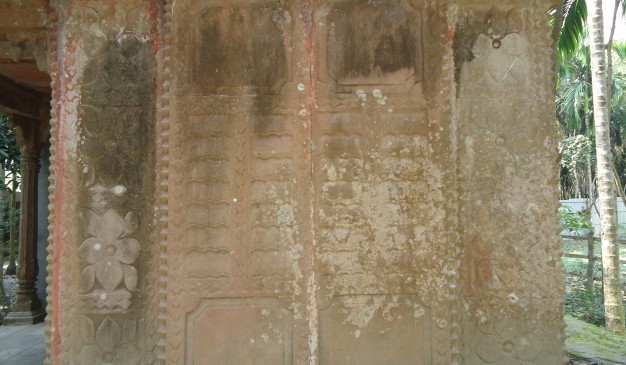
Poddar bari, or according to the local people, the "Panam Rajbari". This is a bit eastern side to the panam city. If someone wants to visit the place, then there is no way except passing through the panam city. This is currently a private property, and there is a picnic spot inside the boundary of the place. The owner of the place used to live at the newly built building beside the old one. But the old one is still empty.
After getting permission you can easily enter the area. Its not known when the building was actually built. But from the structure, and the design, it appears that it was built by some rich merchant during the 1900 AD. The structure and the design is almost identical to the Sonargaon Folk art and craft Museum. Inside the building, the yard is identical to the museum building of sonargaon.
The building comprises of numerous number of rooms. And interestingly you can move from one room to another one easily. There is no window at the rooms, and also no doors, most of those are taken down, or stolen, or something else. Since its a bit darker inside the building, its a hideout for the bats. When camera flashed, we have seen several bats were flying and making noisy sound. Also there nest of other birds which are making continuum sound, but we bet you won't feel bored by those. Those are really nice to hear. So if you are at sonargaon, please don't leave the place by only visiting the panam city. It will worth if you visit the place.
)
[1] => Array
(
[name] => Tokani Pal House
[post_id] => 8643
[post_link] => http://offroadbangladesh.com/bn/places/tokani-pal-house/
[thumb_link] => http://offroadbangladesh.com/wp-content/uploads/2015/05/TPP-12-300x200.jpg
[post_content] =>
Munshiganj, or Bikrampur as it was formerly known as home to a number of rich landlords and merchants, who lived in palatial houses, built on large estates. Most of these perished in course of time as the mighty Padma River devoured most of Bikrampur. Of all that remain in today’s Munshiganj, the largest is the house at Abdullahpur, known as Tokani Pal House (টোকানী পাল বাড়ি). There isn’t enough source to know about who built this house, but Tokani Pal, an elderly merchant from Barisal, bought this 7 acre estate and moved in here sometime in the early 1890s. His second wife Nabanga Sundary and all six sons from his two marriages accompanied him.
The estate now consists of 11 buildings and six ponds. The sprawling gardens have hundreds of trees – fruit bearing, medicinal, or for wood itself. And there were once several hundreds of flowering plants. But when Tokani arrived, the estate was in a mess. Kamini Pal, the eldest son of Tokani,took charge of cleaning up the estate. He chose a place to set up a temple, dedicated to Radha-Shyam, of whom they had been followers for generations. By this time, the masons of Abdullahpur had made a name in craftsmanship and expertise, and Arfan Ostagar was the most revered of all. He was hired, for a daily fee of five quarters and a pack of tobacco. His designer had to be paid an additional three quarters. A 15X6 feet room was planned to build, with a wide sprawling varanda, where followers could sing devotional songs every evening. The room would have a large platform, on which would rest a large metal statue of Radha-Shyam. The exterior wall would be decorated with fine ceramic designs. Once completed, the temple became a marvel, people from far and wide came over to see.
The Pal’s principal business was surrounded around the Kamala river port of Bikrampur, which was known as the Second Kolkata. Betelnuts, mustard, lentils etc would arrive from Barisal or Chandpur, and would be traded with Kolkata. Almost 20,000 laborers worked daily at this port, where the second largest wholesalers were the Pals. They set up warehouses at places as far as Barisal, Jhalokathhi or Shwarupkathhi, or Chandpur. Kamini Pal also became the most prominent money-lender. Dwarkanath became a prominent dealer in Kerosene oil. Other brothers also chipped in here and there. Business for the Pals was running well.
After the Partition of India, a large section of the family moved to Kolkata. Those who remained to protect the family businesses, soon found it difficult, as business with Kolkata became complicated. They had to explore new business avenues, but that wasn’t too easy.
In 1971, Hindus were being tortured or killed, their businesses were being shut down, their houses were being torched. The Pal estate being protected with a strong high boundary wall became a safe refuge, not only for members of this family, but for members of extended families, and also for friends and their families. About 500 people had found safe shelter here, until one dark night, when the Pakistani Army entered the compounds, killed several family members, and set the main houses of fire. The entire clan moved to India through Agartala.
Almost two years later, Shashadhar Pal, the second son of Dwarkanath Pal, who by then was head of the clan, returned with his family. But by this time major parts of the estate had been grabbed and taken over by others. He tried to revive some of the businesses, but did not quite succeed. His family members went back to Kolkata, but he decided to stay back, reminiscing his childhood memories, and gradually selling off part of their properties. He lived either in one of the houses within this estate, or in the other Pal House, which also was built by his uncle Kamini Pal several decades ago. He passed away in the late 1990s.
)
[2] => Array
(
[name] => Nagarpur Zamindar Bari
[post_id] => 7241
[post_link] => http://offroadbangladesh.com/bn/places/nagarpur-zamindar-bari/
[thumb_link] => http://offroadbangladesh.com/wp-content/uploads/2015/04/Nagorpur-jomidar-Bari-021-300x225.jpg
[post_content] =>
Nagarpur Zamindar Bari (নাগরপুর জমিদার বাড়ী) is located at the Nagarpur Upazila of Tangail district. This place is located in an interesting area. It has river Dhaleswari at the eastern side, and the River Jamuna at the western side. It is believed that there were a naval route between the Kolkata and Nagarpur that time. Now the Zamindari system has vanished and it took that route along with that.
The Zamindari of Nagarpur was established during the 19th century by the Jodunath Chowdhury. It's right now a massive complex which is known as Choudhury Bari as well. They are very helpful towards the people of their area. One of the decedent from the family named Suresh Chandra Ray Choudhury was the founder secretary of the famous club East Bengal from this Sub-continent.
Most of the buildings from the complex are in ruin, and few are in good condition. Using those good ones the government has established Nagarpur Mohila Degree College. If you enter inside the dilapidated section of the complex, you can find a hideout for the bats. There are probably thousands of bats rest and start flying away after people’s presence, which create a sharp wind flow from the flapping of the wings of the bats.
)
[3] => Array
(
[name] => Nawab Faizunnesa Chowdhurani and Nawab Bari
[post_id] => 5531
[post_link] => http://offroadbangladesh.com/bn/places/nawab-faizunnesa-chowdhurani-and-nawab-bari/
[thumb_link] => http://offroadbangladesh.com/wp-content/uploads/2015/03/Choudhurani-Nawab-Faizunnesa11-201x300.jpg
[post_content] =>
Nawab Faizunnesa Choudhurani (1834–1903) was Zamindar of Homnabad-Pashchimgaon Estate in present-day Comilla District, Bangladesh. She is most famous for her campaign for female education and other social issues. In appreciation of her social work, in 1889 Queen Victoria awarded Faizunnesa the title of "Nawab", making her the first female Nawab in South Asia.
Early life and background: Nawab Faizunnesa Chowdhurani was born in 1834 in the village of Pashchimgaon under Laksham in the district of Comilla. Her father was Ahmed Ali Chowdhury, a descendent of the Mughal emperors and zamindar of Homnabad-Pashchimgaon estate. Faizunnessa was raised in a conservative Muslim family, where the women would maintain a strict purdah system. She received no formal education but she educated herself in her library during leisure time. She was proficient in Arabic, Persian, Sanskrit and Bengali language. In 1860, Faizunnesa was married to a distant cousin and neighboring Zamindar, Muhammad Gazi, becoming his second wife. But the couple became separated for an unknown reason and Faizunnesa began to live with her paternal family.
Career and philanthropy: After her mother's death in 1883, Faizunnesa inherited her property and became Zamindar of Pashchimgaon. She became increasingly involved in social work after becoming Zamindar. In 1873, Faizunnesa Choudhurani established a high school for girls in Comilla, which is one of the earliest female schools privately established in Indian subcontinent, which is now called Nawab Faizunnesa Government Girls' High School. She also founded a school at Pashchimgaon that was later upgraded to a college and now named as Nawab Faizunnesa Degree College.
In 1893, Faizunnesa established a charitable dispensary in her village for women in purdah, particularly destitute women. She also built a hospital for women, Faizunnesa Zenana Hospital in Comilla. In addition, she built mosques and contributed towards the development of roads and ponds. Faizunnesa patronized different newspapers and periodicals, including Bandhab, Dhaka Prakash, Musalman Bandhu, Sudhakar, and Islam Pracharak. Before her death in 1903 she donated her entire property to the nation.
)
)