Array
(
[0] => Array
(
[name] => Shahjadpur Mosque
[post_id] => 3085
[post_link] => http://offroadbangladesh.com/bn/places/shahjadpur-mosque/
[thumb_link] => http://offroadbangladesh.com/wp-content/uploads/2015/02/Shahzadpur-Masjid-Banglapedia1.jpg
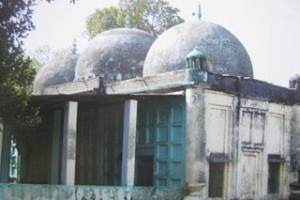
[post_content] => It was built in 1528 in ancient Bangla. Many people believe that it is a 15
th century architecture which was built by Shah Mokdum(R). There is no inscription found for any date. Shahjadpur mosque stands on the bank of the river Hurasagar at Dargapara, the extreme end of Shahjadpur proper, in the district of Sirajganj. It is not dated by any inscription. Architectural as well as decorative features of the mosque point to its 15th century origin. Its architectural and decorative features indicate that it is of the 15
th century. It has a rectangular multi domed shape. Externally it is 19.13m tall and 12.6m wide and internally it is 15.77m tall and 9.60m wide. Its walls are 1.5m thick. Inside we can find 2 rows made of stone pillars and they carry pointed archways. There are 8 black slag pillars. There are 5 arched entrances in the mosque parallel to the west wall mihrab.
There are eight black basalt pillars, square at the base, then octagonal, and having a square capital on the top. The mosque is entered by five impressive arched entrances parallel to the mihrabs in the west wall. There are three blind niches on the south and north sides where the openings would have been. There are two subsidiary mihrabs on the left side of the central mihrab, and one on the right side. The place of another mihrab on the right side of the central mihrab is occupied by the mimbar of the mosque. The plan shows five bays and three aisles, allowing for fifteen uniform domes over the roof. The decoration and roof the mosque is slightly curved which dates back during time of Sultanate period. This mosque resembles features of early Sultanate period of Bengal.
)
[1] => Array
(
[name] => Kismat-Maria Mosque
[post_id] => 9282
[post_link] => http://offroadbangladesh.com/bn/places/kismat-maria-mosque/
[thumb_link] => http://offroadbangladesh.com/wp-content/uploads/2015/05/kismat-maria-mosque-durgapur-rajshahi-12-300x225.jpg
[post_content] =>
Kismat-Maria Mosque (কিসমত-মারিয়া মসজিদ) is the academic name, where local people knows this as Durgapur mosque (দুর্গাপুর মসজিদ). The mosque is located at the Maria (মারিয়া) village, adjacent to village Kismat (কিসমত), that's why it is called Kismat-Maria Masjid.
It is totally unknown about any sort of historical information. No inscription available at the doorway or anywhere. Even the government doesn't have any document or info regarding this. To add insult to the injury, the local people cannot remember anything about this mosque either. It’s a total mystery.
It is certain that the mosque was built several hundred years back. It is having three domes at the top. Four ornate pillars at the four sides of the mosque. Eastern side of the mosque is having three entrances. The mosque is built over a 2-3 feet of high base. The domes of the mosque is similar to the Kartalab Khan's Mosque at Old Dhaka.
The mosque has a small house type of building at the southern side. This is another great archaeological object from our Bangladesh.
)
[2] => Array
(
[name] => Khwaja Shahbaz Mosque and Tomb
[post_id] => 7357
[post_link] => http://offroadbangladesh.com/bn/places/khwaja-shahbaz-mosque-and-tomb/
[thumb_link] => http://offroadbangladesh.com/wp-content/uploads/2015/04/Khwaja-Shahbaz-Mosque-and-Tomb31-300x240.jpg
[post_content] =>
Khwaja Shahbaz, the founder of the mosque was a prominent merchant of Dhaka. In fact, prominent is not the paragon for him. People used to call him as "Merchant of Prince". According to the history of the mosque, it was built at 1679 AD in the surrounding of the Ramna Park.
The mosque has three large Domes, and the architecture is almost similar to the structures at the era of Mughal (Shaista Khan). The measurement of the mosque is exactly 20.73 m by 7.92m. It is comprises with three front doors, where the middle one is a bit larger compare if you compare with other two.
As a commemoration, the mosque premise has a tomb of the founder of the mosque. The tomb is decorated with only a single dome. The southern part of the tomb has a nicely shaped veranda with a curvy roof. Inside the tomb, there is something which is covered with red cloth.
Each corner of the mosque or the tomb has a firmly built pillar, which are lovely to examine. The baroque style of the pillar will certainly impress you. Neither the mosque nor the tomb has any window. That's why when you'll look inside the tomb or mosque, you'll find it a bit darker, no matter how sunny the day is. Finally it is strictly forbidden for the women for "Jumma Prayer" at Friday. Using a notice board at the facade of the mosque, it’s proclaimed that they have no facilities for women for Jumma Prayer.
)
[3] => Array
(
[name] => Nayabad Mosque
[post_id] => 1990
[post_link] => http://offroadbangladesh.com/bn/places/nayabad-mosque/
[thumb_link] => http://offroadbangladesh.com/wp-content/uploads/2015/02/Nayabad-mosque1-300x211.png
[post_content] =>
Nayabad Mosque is located in the bank of the river Dhepa, just 1.5 km south-west of the infamous Kantaji Temple at Dinajpur in Bangladesh. The mosque is named after the village “Nayabad” in which it stands in the Police Station of Kaharole. According to an inscription found on the central doorway, it was constructed at 1793 AD in the reign of Mughal Emperor Shah Alam II. During that period, Raja Baidyanath, the last of the Dinajpur Royal family, was the Zaminder (feudal land owner).
Nayabad Mosque was erected at a time when the soil of Dinajpur had already been enriched with one of the most remarkable Navaratna temples, the Kantajew Temple in 1752 AD. The founding Royal family of Dinajpur was still prominent. According to local traditions, the mosque was built by Muslim architectural workers who had come to this place from the west to build Kantaji Temple. They had settled in Nayabad, a village near the temple, and had built the mosque for their own use. There is a grave of an unknown person in the premises of the mosque. Local people believe, this is the grave of Kalu Khan, the master architect of Kantaji Temple.
It is an oblong three-domed mosque with octagonal towers at the four corners. There are three arched entrances to enter the mosque. Among them, the central one is bigger than the flanking ones. These are equal in height and width. There is an arched window each on the south and north sides. Inside in the western wall there are three Mihrabs in line with the three entrances. The central Mihrab is bigger than the flanking ones which are of equal size. Three hemispherical domes cover the mosque, of which the central one is bigger than the side ones. Pendentives have been used in their phase of transition. The parapet and cornice are straight.
Terracotta plaques have been used in decoration of the mosque. At present there are about 104 terracotta plaques rectangular in shape, used in the surface decoration of the mosque walls. The platform of the mosque is enclosed by a low brick wall with only one access from the east. On either side of the mosque are to be seen a number of tombs each of found fixed over the central doorway of the mosque.
)
)