Brief
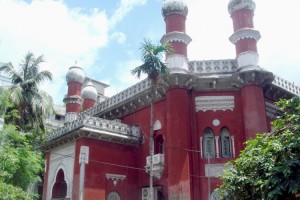
Northbrook Hall, also called Lalkuthi (লালকুঠি), is an Indo-Saracen building, and a fusion of Mughal architecture and European Renaissance architectural styles. The semi-circular horseshoe arches contain the main entrance on the north side. The four octagonal minarets on the north side, along with pinnacles and ornamental parapet, show the Muslim and Mughal features. The windows, doors and walls were ornate, following the European style, but the domes at the top of the building were ornate following the Muslim style.
In 1874, Indian Governor Thomas George Baring, Lord Northbrook, the Viceroy of India between 1872 and 1876, came to visit Dhaka. In order to make his visit memorable, Raja Rai Bahadur, along with eminent Zamidars and affluent citizens of Dhaka, donated 10 thousand and 5 thousand taka each to build the Town Hall in 1879. Abhay Chandra Das was the committee secretary. In 1880, the Commissioner of Dhaka inaugurated it and the personal orchestra of Nawab Abdul Ghani was brought to entertain the commissioner and the guests on inauguration.
On February 8, 1882, a public library was added on the south-east side of the Hall. It was named the Northbrook Public Library and became known for its literary collection. Many books were ruined during the 1971 Liberation War. To re-establish the library, the Maharaja of Tripura donated 1000 TK, the Zamidar of Baliati Brojendro Kumar Roy 1000 TK, Queen Shornomoi 700 TK, Kalikhrishno 500 TK and Bishaishori Devi donated 500 TK. In 1887, the library opened with 1000 books.
A clubhouse was added to the south-side and called Johnson Hall. At Northbrook Hall, Nobel Laureate poet Rabindranath Tagore was honoured by Dhaka Municipality and the People’s Association on 7 February 1926. In 1950, Northbrook Hall was used as a telegram office, and later as the Central Women’s College. The building is the property of Dhaka Municipality Corporation.
The Buriganga River could be seen from the Northbrook hall when it was built but by 1930, the riverfront and the river was obscured. The area lost its importance and residential character and had transformed into a commercial area. In 1998, a government education office was built by the side of Northbrook Hall, part of which is now used by a decorator, and a pentagram fountain in front of the north entrance now completely obscures the view.
The Northbrook Hall is one of the protected buildings under the Department of Archaeology. Over the years, several phases of restoration work were undertaken by the Department of Archaeology, in coordination with the Dhaka Municipality Corporation. As the bed on the ornamentations and surface painting on most occasions. However, as the building is more than 130 years old, on few instances, comparatively major restoration uilding has been actively in use for over a century, only minor restorations were requirworks were required, especially for the condensation of the plaster work and paint.
The restoration works at the Northbrook Hall were more convenient for the Department of Archaeology, as the Dhaka Municipality Corporation actively supported the projects; along with the users, the local community. As there has been no disruption in the use of the building for over a century, the original details of the jalli work and surface ornamentations has survived in very good shape. Also, as the building is actively used and in relatively good shape compared to the other vulnerable heritage, no special fund was required for the conservation (as seen in the other examples like Panamnagar). The users of the building took partial responsibility of the minor restoration works under the supervision of the Department of Archaeology. The Northbrook Hall can be considered one of the more successful formal conservation projects undertaken by the Department of Archaeology.
One of the major threats for the heritage building is the encroaching structures, like an assembly hall and a few community canters built surrounding the building. Another critical factor is the ‘List of Protected Heritage’ published in 2009. Before the list was published, the collaboration between the local community, Dhaka Municipal Corporation and the Department of Archaeology was flexible. Perhaps, this is one of the reasons why the building is better conserved.
Array
(
[0] => Array
(
[name] => Mirkadim Bridge
[post_id] => 8217
[post_link] => http://offroadbangladesh.com/places/mirkadim-bridge/
[thumb_link] => http://offroadbangladesh.com/wp-content/uploads/2015/05/Mirkadim-Bridge-11-300x200.jpg
[post_content] =>
Mirkadim bridge (মীরকাদিম ব্রিজ) spans the Mir Kadim canal (creek) which runs from Mir Kadim to Tangibari. It connects the village Abdullahpur and Panam area of Rampal Union Parishad under Munshigonj District. It is situated at a distance of about 5.50 km from the district headquarters. The local tradition claims it to have been built by King Ballal Sen, but the architectural features belie the local tradition. The bridge can architecturally be attributed to the Mughal period, not earlier than 17th century. The 53m long bridge consists of a central pointed arch of 4.40m span with two side arches of 2.25m span each. The central arch is 0.40m high from the water level of the creek and at present 31m wide. It is 6.15m wide with each wing measuring 16.80m in length. The central arch is flanked by an octagonal pilaster on each side. Similarly each of the side arches has a pilaster each crowned with a cupola. The plasters of the side arches rise above the spandrel of the arch but those of the central arch are shorter and so not reach the archivolt. The pier is 1.85m thick. It is reported that on either end of the bridge there were circular pillars but now these are buried under earth. It appears that there are 6 piers on each side of the bridge. The central arch is loftier and wider than the side ones and is set in a deep rectangular panel with plain plastered spandrel. Base of the arches provided with cut waters. The hump backed bridge rises to a central point from which its back gently slopes to either side. It has a 70 cm high parapet wall on either side. The surviving thickness of the bridge measures 4.34m.
It has been protected and repaired extensively by the Department of Archaeology.
)
[1] => Array
(
[name] => Teesta Railway Bridge
[post_id] => 6434
[post_link] => http://offroadbangladesh.com/places/teesta-railway-bridge/
[thumb_link] => http://offroadbangladesh.com/wp-content/uploads/2015/04/tista-barrage1-300x200.jpg
[post_content] =>
Teesta Railway Bridge is the third largest railway bridge of the country lengths about 2000 feet and constructed in the year 1834.
In 1978, to manage load of road vehicles for Lalmonirhat, Kurigram and beyond by ferry, the then president Ziaur Rahman instructed the Railway and Roads authority to set wooden sleepers in the rail bridge between the rails for all types of vehicular movement. Same year, March 4, President Ziaur Rahman inaugurated the bridge for vehicular movement. The bridge restores the communication from divisional headquarters of Rangpur with two districts, Lalmonirhat and Kurigram.
The bridge is now in broken-down condition and needs major repair. For motor vehicles construction of a road bridge began next to it in 2006 for completion by 2009 at a cost of Tk 1.22 billion which is now expected to be opened in June 2012.
)
[2] => Array
(
[name] => {:en}Government Buffalo Farm{:}{:bn}মহিষের খামার{:}
[post_id] => 6536
[post_link] => http://offroadbangladesh.com/places/government-buffalo-farm/
[thumb_link] => http://offroadbangladesh.com/wp-content/uploads/2015/04/Mohisher-Khamar-buffalo-farm-011-300x226.jpg
[post_content] => {:en}
Government Buffalo Farm in Bangladesh was started by the government at 1984 for the better reproduction of buffalo. Also they had a plan to supply the hybrid buffalo to the farmers in a low cost, so that they can use that for plowing the land. But similar to many other government's concerns, this project also never got enlightened latter. It is a vast area and one side is bounded by a canal or river. It has a very wide open field inside (for grazing).
[This spot needs more detail. If you have more information and photos, please be advised to add in our website. Your name will be published as a Content Contributor]
{:}{:bn}
মহিষের উন্নত বংশবৃদ্ধির লক্ষ্যে সরকার ১৯৮৪ সালে মহিষের খামার চালু করে। হাইব্রিড জাতের মহিষ উৎপাদন এবং কৃষকের কাছে এসব মহিষ স্বল্প দামে পৌঁছে দেওয়াও ছিল এই খামার চালুর উদ্দেশ্য যাতে করে কৃষকরা এসব মহিষ হালচাষের কাজে ব্যবহার করতে পারে। বিশাল এলাকার উপর অবস্থিত এই খামারের এক প্রান্তে নদী রয়েছে এবং খামারের অভ্যন্তরে গোচারনভূমি হিসেবে ব্যবহারের জন্য প্রশস্ত বিশাল মাঠ রয়েছে।
{:}
)
[3] => Array
(
[name] => {:en}Meghna Bridge{:}{:bn}মেঘনা সেতু{:}
[post_id] => 5509
[post_link] => http://offroadbangladesh.com/places/meghna-bridge/
[thumb_link] => http://offroadbangladesh.com/wp-content/uploads/2015/03/meghna-bridge-F.-Zaman1-300x187.jpg
[post_content] => {:en}
Official name of Meghna Bridge is Japan Bangladesh Friendship Bridge 1. It carries Motor vehicles and pedestrians. It is situated over the Meghna River. This bridge was designed by Cantilever bridge. The total length of the bridge is 900 meters (2,952 ft 9 inches), in width 9.2 meters (30 ft 2 inches). The longest span is 87 meters (285 ft 5 inches). It was opened for public in February 1, 1991. The coordinates is 23°36.162′N 90°36.991′E
Meghna Bridge is a road bridge in Bangladesh. It was built by assistance of Japan and officially named Japan Bangladesh Friendship Bridge 1, but it is popularly known as Meghna Bridge. According to a study conducted in 2004 by the Embassy of Japan in Bangladesh, residents living around the Meghna Bridge recognized several positive impacts after the construction of the bridge. In 2005, the bridge underwent extensive repair because the expansion joints of the bridge were damaged due to the lack of appropriate maintenance.
Architecture: Meghna Bridge is a cantilever and girder bridge. It is 930 meters (3,051 ft 2 in) in length with dual carriageway and 9.2 meters (30 ft 2 in) in width. The bridge has thirteen spans. Two among the individual spans are of 24.25 meters (79 ft 7 in) in length each, one is of 48.3 meters (158 ft 6 in) in length, nine spans are of 87 meters (285 ft 5 in) in length each and the length of the rest is 18.2 meters (59 ft 9 in). The carriage way of the bridge is 7.2 meters (23 ft 7 in). The foundations are supported on RCC caissons and piles. Piled foundation of abutments are buried. RCC caissons which are used as foundation under the piers are also buried. Both abutments and the piers of the bridge are RCC solid type. The piers of the bridge are hexagonal. Each pier is of 11 meters (36 ft 1 in) in length and 3.2 meters (10 ft 6 in) in width.
The wing walls of the bridge are of RCC and are fixed with abutments and have no weep holes. Railing type of the bridge is of R.C.C post and steel rail. The bridge has 0.80 meters (2 ft 7 in) wide sidewalk at both sides. Meghna Bridge also has infrastructure of drainage.
Economic impact: Traffic volumes across the Meghna River and of National Highway No. 1 significantly increased after the opening of the Meghna Bridge. In April 1997, an average of 10,149 vehicles of all types used the bridge in each 24 hours while March 2004 saw 9,704 vehicles per day. The reason behind this fall in traffic volume is attributed to increase in toll rate in 2002 and seasonal fluctuations. Below is a comparison of vehicles using the bridge per day in April 1997 and March 2004.
The survey conducted in 2004 by the Embassy of Japan in Bangladesh found that a majority of the users of the bridge believe that the construction of the Meghna Bridge improved the life of the people living near it and the surrounding area of the bridge has been urbanized. The people surveyed opined that the number of traffic blockage caused by bad weather has been decreased since the construction. The survey also found that 42% of the trucks using Meghna Bridge transport goods between Dhaka and Chittagong.
{:}{:bn}
মেঘনা সেতু নামে বহুল পরিচিত এই সেতুটির দাপ্তরিক নাম হল জাপান-বাংলাদেশ মৈত্রী সেতু-১। ক্যাণ্টিলিভার ব্রিজের নকশায় নির্মিত এই সেতুতে যানবাহন এবং পথচারি চলাচলের ব্যবস্থা আছে। জাপানের সহায়তায় নির্মিত সেতুটির মোট দৈর্ঘ্য ৯০০ মিটার (২৯৫২ ফুট ৯ ইঞ্চি) এবং প্রস্থ ৯.২ মিটার (৩০ ফুট ২ ইঞ্চি। ১৯৯১ সালের ১লা ফেব্রুয়ারি সেতুটি যান চলাচলের জন্য উন্মুক্ত করে দেওয়া হয়। সেতুটির জিপিএস অবস্থান হল ২৩°৩৬.১৬২′উ ৯০°৩৬.৯৯১′পু।
২০০৪ সালে জাপান দূতাবাস পরিচালিত একটি সমীক্ষায় দেখা যায় সেতুটি নির্মাণের ফলে সেতুর আশেপাশে বসবাসকারীদের জীবন মান বৃদ্ধি পাওয়ার পাশাপাশি সেতুর আশেপাশের এলাকারও শহরিকরন হয়েছে। জরিপে অংশগ্রহনকারীরা জানিয়েছেন যে খারাপ আবহাওয়ার কারনে সেতুর উপর যান চলাচল বাধাগ্রস্থ হওয়ার ঘটনা পূর্বের চেয়ে লোপ পেয়েছে। জরিপ থেকে এও জানা যায় যে, সেতুতে চলাচলকারী ৪২% ট্রাক ঢাকা ও চট্রগ্রামের মধ্যে পণ্য পরিবহন করে থাকে।
যথাযথ রক্ষনাবেক্ষনের অভাবে এবং অধিক ওজনের যানবাহন চলাচলের জন্য সেতুটির বেশকিছু অংশে এক্সপেনশন জয়েন্ট ক্ষতিগ্রস্থ হওয়ায় ২০০৫ সালে সেতুটিতে বড় ধরনের মেরামত কাজ পরিচালনা করা হয়।
স্থাপত্যঃ ক্যাণ্টিলিভার এবং গার্ডারে নির্মিত এই সেতুতে উভয় দিকে যান চলাচল করতে পারে। সেতুটির ১৩টি স্প্যানের মধ্যে দুটি স্প্যানের দৈর্ঘ্য ২৪.২৫ মিটার (৭৯ ফুট ৭ ইঞ্চি), একটি স্প্যানের দৈর্ঘ্য ৪৮.৩ মিটার (১৫৮ ফুট ৬ ইঞ্চি), নয়টি স্প্যানের দৈর্ঘ্য ৮৭ মিটার (২৮৫ ফুট ৫ ইঞ্চি) এবং বাকি একটি স্প্যানের দৈর্ঘ্য ১৮.২ মিটার (৫৯ ফুট ৯ ইঞ্চি)। মেঘনা সেতুর মূল সড়কপথের দৈর্ঘ্য ৭.২ মিটার (২৩ ফুট ৭ ইঞ্চি)। সেতুটির ফাউণ্ডেশন নদীতলে গেঁথে দেওয়া আরসিসি প্রকোষ্ঠ এবং পাইলের উপর করা হয়েছে। সেতুটির পিলার এবং ভারবাহী স্তম্ভগুলো আরসিসি দিয়ে নির্মিত। ষড়ভুজ আকৃতির সেতুটির একেকটি ভারবাহী বস্তুর দৈর্ঘ্য ১১ মিটার (৩৬ ফুট ১ ইঞ্চি) এবং প্রস্থ ৩.২ মিটার (১০ ফুট ৬ ইঞ্চি)। পিলারের সাথে যুক্ত সেতুটির পার্শ্ব দেয়াল আরসিসি দিয়ে তৈরি। আরসিসি পোস্ট প্রকৃতির মেঘনা সেতুর রেলিং স্টিলের তৈরি । পানি নিষ্কাশনের ব্যবস্থা সহ সেতুটির উভয়দিকে হাঁটার জন্য ০.৮০ মিটার (২ ফুট ৭ ইঞ্চি) প্রস্থ ফুটপাথ রয়েছে।
অর্থনীতির উপর প্রভাবঃ মেঘনা সেতু উদ্বোধনের পর এই সেতুতে এবং ১ নং জাতীয় মহাসড়কে যান চলাচল উল্ল্যেখযোগ্য পরিমানে বৃদ্ধি পায়। তবে ২০০২ সালে সেতুটিতে চলার জন্য টোলের পরিমান বৃদ্ধির পর যান চলাচল কমে আসে। উদাহরন হিসেবে বলা যায় যে ১৯৯৭ সালের এপ্রিলে ২৪ ঘণ্টায় গড়ে প্রায় ১০১৪৯ টি সব ধরনের যানবাহন সেতুটি অতিক্রম করে। অন্যদিকে ২০০৪ সালের মার্চে ৯৭০৪ টি যানবাহন গড়ে প্রতিদিন এই সেতুটি অতিক্রম করে।
{:}
)
)