Where to Stay
There are more than 71 quality hotel in Dhaka. Some are listed below…
1. Pan Pacific Sonargaon Hotel, Dhaka
107 , Kazi Nazrul Islam Avenue
Dhaka, Bangladesh
Tel: +880 2 811 1005
Website : Pan Pacific Sonargaon Hotel, Dhaka
2. Ruposhi Bangla Hotel
1 Minto Road, Shahbagh, Dhaka,
Bangladesh.
Phone : 88-02-8330001
Fax : 88-02-8312975
Email : sales@ruposhibanglahotel.com
Website : Ruposhi Bangla Hotel
3. Radisson Water Garden Hotel, Dhaka
Airport Road, Dhaka Cantonment,
Dhaka 1206 Bangladesh.
Telephone: + 88 02 8754555
Fax: + 88 02 8754554 , + 88 02 8754504
Email : reservations.dhaka[at]radisson.com
Website : Radisson Water Garden Hotel
Dhaka Bangladesh
4. Dhaka Regency Hotel & Resort
Airport Road, Nikunja 2
Dhaka 1229, Bangladesh.
Phone : +88-02-8913912, +880 2 8900250-9
Fax : +88-02-8911479
Email : info@dhakaregency.com
Website : www.dhakaregency.com
5. Best Western La Vinci Hotel, Dhaka
54, Kawran Bazar,
Dhaka-1215, Bangladesh
Phone No : 880-2-9119352
Fax No : 880-2-9131218
E-mail : lavinci[at]bol-online.com ,
reservation[at]lavincihotel.com
Web : www.lavincihotel.com
Array
(
[0] => Array
(
[name] => Monu Mia Zamindar House
[post_id] => 7799
[post_link] => http://offroadbangladesh.com/places/monu-mia-zamindar-house/
[thumb_link] => http://offroadbangladesh.com/wp-content/uploads/2015/04/10444626_533621976768790_1482189310827828612_n-300x200.jpg
[post_content] =>
Monu Mia Zamindar House, a massive Palace with two conjunctive complex located very near to the Ghorashal Bus-stand of Narsingdi. It was reconstructed in the 1335 BE (Bengali Era) by a land lord of this region named Sazda Mia. This Zamindar House is one of the greatest examples of Classical Colonial Architecture in Bangladesh.
At the front view, meticulously designed Corinthian Columns, arch shaped door, decorated Parapet with leaf's motifs will certainly arise the attraction to observe its inner beauty. Inside of this Palace, it is well furnished and decorated with distinguish design. The temperature in the palace always stays little down than the outside yard.
In the front of the house, there is a huge space for porch. Several ponds surrounding the Palace increases its beauty.
)
[1] => Array
(
[name] => Ulpur Zamindar Bari
[post_id] => 18413
[post_link] => http://offroadbangladesh.com/places/ulpur-zamindar-bari/
[thumb_link] => http://offroadbangladesh.com/wp-content/uploads/2015/09/Ulpur-Jomidarbari-1-300x169.jpg
[post_content] =>
During 1850, the greater Gopalganj area was ruled by the Zamindar. At that time, they made hundreds of buildings for their residence and official purposes. The buildings were made in the traditional Zamindar Bari look and style. In the last 150 years, most of the houses were destroyed by erosion. After being taken by the government, the authority turned some of these houses into government buildings. Now, most of the houses are abandoned or occupied by local people.
There is a cluster of old buildings in the Ulpur Area which is situated in the Gopalgonj - Takerhat highway, not so far from the Gopalgonj main town. As soon as you cross the Ulpur bridge from Ulpur bazar, the buildings start to appear. The first one was used as the Union Land Office (Government) but is now abandoned. The local people over there are now using it to stock fodder.
The second was probably used as a duplex residential complex but now is being used as the Sub Post Office. The surrounding environment is good and the building is covered by bamboo stocks. In the main road, there is a large old building, which was probably the main building. Outside this building the words "Dinesh Dham" in Bengali is carved in a white slate. This building is currently occupied by some local inhabitants.
If we go farther, then we will see another broken house formerly used as the Upazilla Registry office, now almost completely in ruins. "Din-Dham" in Bengali is also carved outside he building in white stone.
The overall environment of this village is very good and peaceful. Walking for an hour in the silence of this area will be relaxing. The most attractive structure is the Temple. The walls of the temple is decorated with colorful glass & ceramics. The temple looks good but it is also abandoned so the temple has shifted into a newly constructed building.
)
[2] => Array
(
[name] => Ghughudanga Zamindar Bari
[post_id] => 1977
[post_link] => http://offroadbangladesh.com/places/ghughudnga-zamindar-bari/
[thumb_link] => http://offroadbangladesh.com/wp-content/uploads/2015/02/Ghu-Ghu-Danga-Zamindar-Bari1-300x186.jpg
[post_content] =>
Ghughudanga Zamindar Bari was the residential palace Ghughu-Danga Zamindar Family. It is located onthe side of the River Purnovoba in Dinajpur District. The Zamindar Bari or palace was now damaged byattacking the Pakistani army in 1971 War of Bangladesh. It was built in the Indo-Saracenic renaissance architecture.It is situated six mile away from Dinajpur sadar at Auliapur Union in Dinajpur.
)
[3] => Array
(
[name] => Kusumba Mosque
[post_id] => 3656
[post_link] => http://offroadbangladesh.com/places/kusumba-mosque/
[thumb_link] => http://offroadbangladesh.com/wp-content/uploads/2015/02/84463426-300x199.jpg
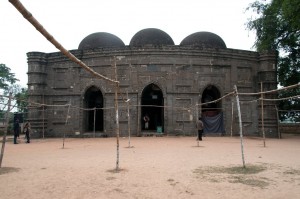
[post_content] => Kusumba Mosque is named after the village of Kusumba, under the Manda upazila of Naogaon district, on the west bank of the Atrai River. It is inside a walled enclosure with a monumental gateway that has standing spaces for guards. It was built during the period of Afghan rule in Bengal under one of the last Suri rulers Ghiyasuddin Bahadur Shah, by one Suleiman who was probably a high ranking official. The inscription tablet in Arabic (only the word ‘built by’ is in Persian) dating the building to 966 AH (1558-59 AD) is fixed over its eastern central entrance.
Although built during Suri rule, it is not influenced at all by the earlier Suri architecture of North India, and is well grounded in the Bengal style. The brick building, gently curved cornice, and the engaged octagonal corner towers are typical features. The mosque, presently protected by the Department of Archaeology of Bangladesh, was badly damaged during the earthquake of 1897. Although the main fabric of the building is of brick the entire exterior walls, and the interior up to the arches of the pendentives have stone facing. The columns, platform, floor, and perforated side screens are of stone. The mosque has a rectangular plan with three bays and two aisles, three entrances on the east and two each on the north and south sides.
The central mihrab is projected in the west. The interior west (qibla) wall has two mihrabs on the floor level opposite the central and southeastern entrances, but the one in the northwestern bay is above a raised platform ascended by a staircase on the east. The presence of such a platform in a non-imperial mosque indicates that not only royalty, but nobility and high-ranking officials were also separated from the general public during prayers. The mihrabs have elaborate stone carving. They have cusped arches crowned with kalasa (water pot) motifs, supported on intricately carved stone pillars which have projections and tasseled decorations hanging from chains. Bunches of grapes and vines curve in an almost serpentine manner on the mihrab frames, and kalasas, tendrils and rosettes are reduced to dots.
The platform edge has grape vine decoration, and there are rosettes on the spandrels of the arches supporting the platform, as well as on the mihrab wall. The stone used in the exterior facing is of a coarse quality and carved in shallow relief. Mouldings are most prominent decorative feature on the outside. They divide the walls into upper and lower sections, run all along the curved cornice, around the corner towers, in a straight line below the cornice, and frame the rectangular panels in the east, south and north walls. The spandrels of the central entrance arch are filled with small kalasa and rosette motifs. The north and south sides have screened windows.
)
)