Brief
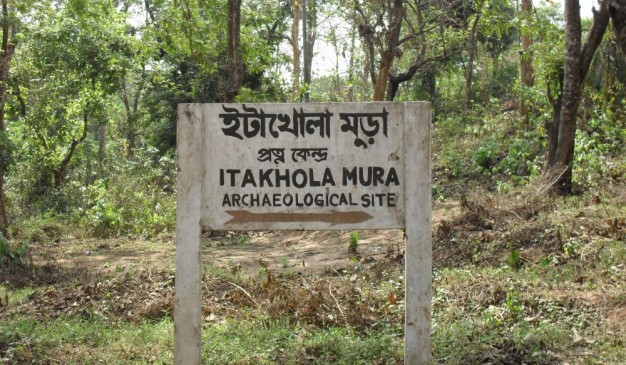
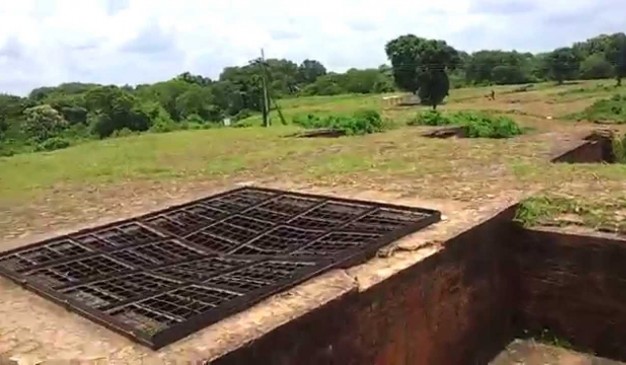
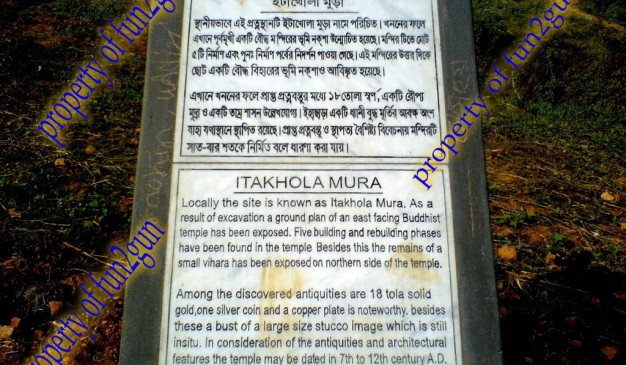
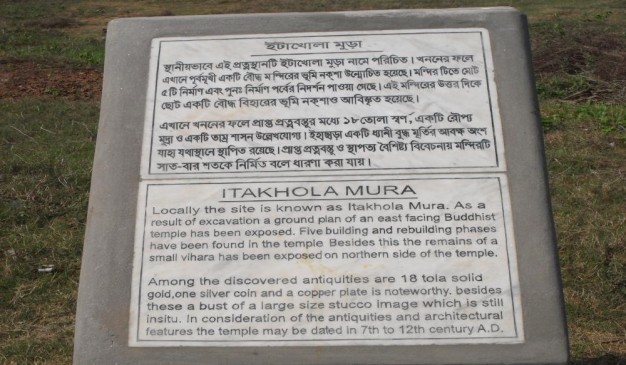
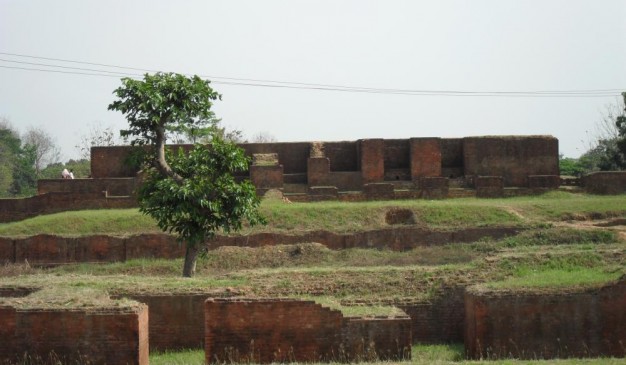
Itakhola Mura is an archaeological site in Mainamati. This site is one of the most impressive ruins. It lies in three terraces on adjacent hillocks just opposite the Rupban Mura site across the Kotbari road in Comilla. Excavations have revealed here a grand stupa complex with an attached monastery, located 42m to its north. The cultural phases of the site are stated (or overstated) to be five; the earlier three being still buried underneath the later remains.
The Stupa Complex was originally built as a solid stupa in the traditional style on a 13.1 meter square basement. However, it has one peculiarity; a small sanctum (2.4 m x 2.1 m) built in the center of its eastern or front side.
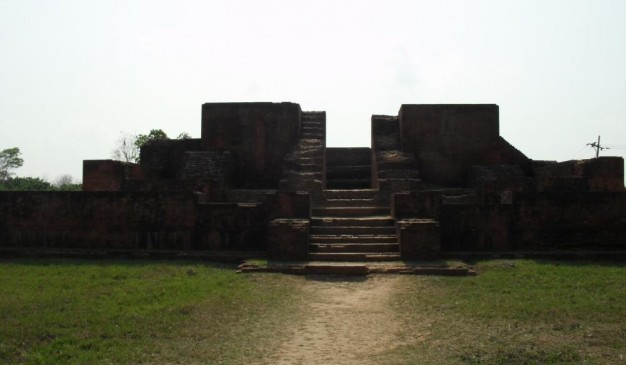
Subsequently, the shrine was enlarged and elaborated by additions and alterations, especially by adding three long narrow chapels in the eastern side after blocking the old sanctum; thus giving the structure an oblong shape (41.4 m x 24m). In this particular feature, it is strikingly similar to the Rupban Mura shrine. The side chapels were ultimately blocked up, leaving space for a few cubicles for installing cult images, as in other parts of the shrine. This establishment is surrounded by a 2.6 m wide circumlocutory passage and is enclosed by a 1.2 m thick boundary wall.
This holy precinct is again enclosed within a much larger, well-defined, and better preserved boundary wall (79 m x 56 m), in the slightly lower second terrace. It contains three interesting subsidiary shrines, two in two corners of the eastern side, and the other, a slightly larger one, at the back in the west. An elaborate entrance with 22 broad steps at the Center of the eastern side leads to the much lower third terrace. The outer face of its damaged boundary wall in this front side is excellently decorated with offsets, sunken panels, and ornamental designs.
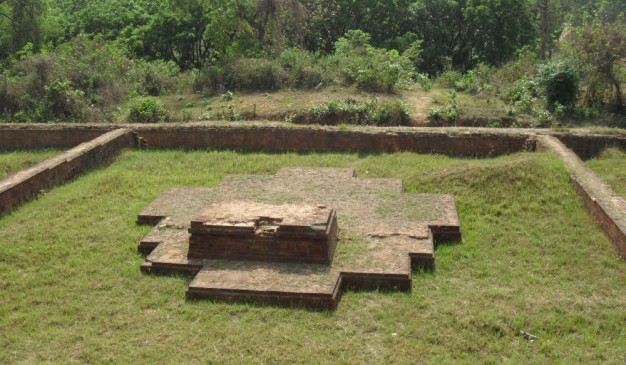
Five votive stupas lie at the base of the long staircase, three of them in a north south row within a well-defined enclosure, all semi-cruciform in shape, like that of the larger subsidiary shrines in the western side of the second terrace. They certainly represent an experimental early stage in the development of the cruciform style in Buddhist architecture that we see in mature form at shalvan vihara, paharpur, Vikramashila and many other sites. These structures may reasonably be dated as belonging to 7th-8th centuries AD.
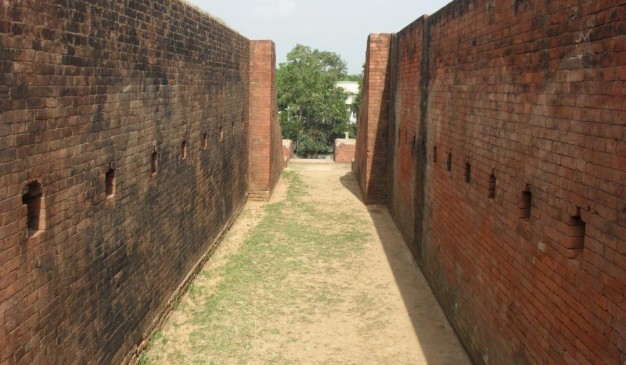
The Monastery This medium sized monastery of the usual square shape with 19 cells and one entrance hall was built around an open courtyard, 16.2m. Square, on a separate mound. Its monumental gateway complex, 17.6m x 8.5m, projecting outwards, lies at the Centre of the eastern wing. Some of the cells have brick-built bedsteads. This structure was badly damaged by brick-hunters in 1944-45.
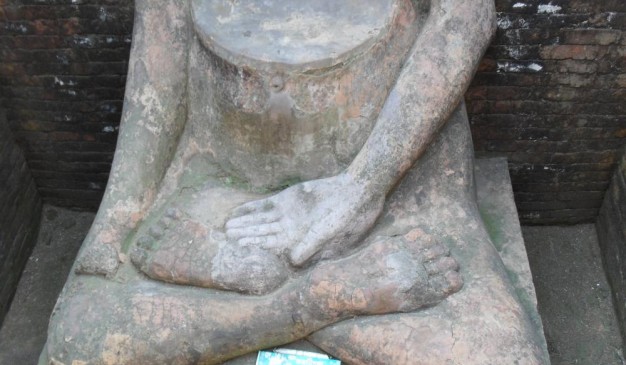
Mentionable antiquities from the site, besides the stucco image, are three round pellets of solid gold, (19 tolas), and a copperplate inscription, discovered during clearance work after the excavations. The copperplate has not yet been deciphered.
Array
(
[0] => Array
(
[name] => Niyogi House
[post_id] => 16728
[post_link] => http://offroadbangladesh.com/bn/places/niyogi-house/
[thumb_link] => http://offroadbangladesh.com/wp-content/uploads/2015/08/niyogee-house-8-300x200.jpg
[post_content] =>
The Niyogi House (নিয়গি বাড়ি) is located at Pukur Para (পুকুর পাড়া) of Singair Upazila. It is a old house built by Ganesh Chandra Niyogi more than 100 years ago. The household comprises of three structures, the principal and largest one is in severe ruins. Not only has the entire roof fallen down, anything that once formed this roof has now disappeared. The large arched doors and windows including their frames too are not to be found anywhere. It had a spacious corridor running the length of the building inside.
Another large building, though too in a dilapidated state is currently being used as the hostel of the local college. The smallest structure that once served as the kitchen has been renovated and is currently being used as accommodation by the Head of the Department of Economics of the same institution. He was there to proudly show us around the premises.
Within the inner compound of the buildings, there is an old well, which shows more waste than water some fifteen feet below. Date inscribed there 1334 Falgun (ফালগুণ) on the wall of this well, declaring this to be at least 87 years old.
)
[1] => Array
(
[name] => Armenian Church
[post_id] => 1413
[post_link] => http://offroadbangladesh.com/bn/places/armenian-church/
[thumb_link] => http://offroadbangladesh.com/wp-content/uploads/2015/02/14688097-300x225.jpg
[post_content] =>
The evidence says about Armenian community in the region during 17th to 18th century and their existence. Armenian Church was build in 1781 on Armenian Street in Armanitola. The site was an American graveyard before before the church built. Agaminus Catachik, an Armenian, gave away the land to build the church. Michel Cerkess, Okotavata Setoor Sevorg, Aga Amnius, and Merkers Poges helped build the church.
Mother Teresa stayed in this church during a visit to Dhaka.
In the old graveyard, among the 350 people buried there, a statue stands at the grave of Catachik Avatik Thomas, portraying his wife. The statue was bought from Kolkata and the grave is inscribed with the words "Best of Husband." Following the domination of their homeland by Persian powers of the time, Armenians were sent by their new rulers to the Bengal region for both political and economic reasons. Although the Armenian presence in South Asia is now insignificant, their presence in Dhaka dates back to the 17th century. Armenians came to Dhaka for business, and have been acknowledged for displaying a passion for trade comparable to that of the Bengalis of the time. In Dhaka, Armenian merchants traded in jute and leather, and profitability in these businesses convinced some to move permanently to Bangladesh. The area where they lived became known as Armanitola.
In 1781 the now famous Armenian Church was built on Armenian Street in Armanitola, then a thriving business district. The site was an Armenian graveyard before the church was built, and the tombstones that have survived serve as a chronicle of Armenian life in the area. Agaminus Catachik, an Armenian, gave away the land to build the church. Michel Cerkess, Okotavata Setoor Sevorg, Aga Amnius, and Merkers Poges helped build the church.
In the fifty years following the church's construction, a clock tower was erected on its western side. Allegedly, the clock could be heard four miles away, and people synchronized their watches with the sound of the tower's bell. The clock stopped in 1880, and an earthquake destroyed the tower in 1897. The Armenian played a prominent part in the jute trade in Dhaka and are reputed to be the pioneers of that trade in the second half of the 19th century. Today, the last Armenian that takes cares of the church is Mikhail Hopcef Martirossian (Micheal Joseph Martin). He was also one of the Armenian who was in the jute trade.
)
[2] => Array
(
[name] => House of Poet Quazi Kader Newaj
[post_id] => 18491
[post_link] => http://offroadbangladesh.com/bn/places/house-of-poet-quazi-kader-newaj-2/
[thumb_link] => http://offroadbangladesh.com/wp-content/uploads/2015/09/house-of-poet-Quazi-Kader-Newaj2-300x225.jpg
[post_content] =>
Historic and archaeological importance of the majestic house of poet Quazi Kader Newaj, an icon of Bangla literature, has been lying uncared in Sreepur upazila town under Magura district, as the authorities concerned are ignoring its tourism potentials.
The poet is specially recalled for his masterpiece of poetry ‘Shikhaker Marjada’. The poet was also a freedom fighter as he played an important role during the liberation war. He was also a good teacher. The poet and his kin were buried along this majestic building.
The splendid building still stands tall along the bank of the Kumar River beckoning the people passing by it to have a look of its grandeur and magnificence. None can resist the temptation of taking a look at the captivating old structure when one passes by it.
In the absence of proper maintenance and renovation, weeds have grown in and around the house while the mossy bricks are crumbling down from the decaying structure. The house has lost much of its charm of terracotta due to the authorities’ negligence. Locals have already taken away many of the bricks, plaques, wooden doors and windows. The house has become a safe haven for drug addicts and gamblers due to lack of proper initiatives for its preservation and maintenance. Local people use the building as their cowshed and it has turned into the public toilet.
Unfortunately, the government has done nothing to renovate the palace, though the historic site can fetch a large amount of revenue every year.
)
[3] => Array
(
[name] => {:en}Mahisantosh{:}{:bn}মহীসন্তোষ{:}
[post_id] => 5807
[post_link] => http://offroadbangladesh.com/bn/places/mahisantosh/
[thumb_link] => http://offroadbangladesh.com/wp-content/uploads/2015/02/offroadbangladeshlogo2-300x178.png
[post_content] => {:en}
Mahisantosh an important center of administration and learning in the medieval period. Present Mahiganj and Santosh under Patnitala in Naogaon district were known as Mahisantosh. There is a legend that a darvesh (saint) came to the place on the back of a fish and hence the name. There is also a tradition that the place was named after mahipala I (c 995-1043 AD). The general plan of the site and the discovery of some military weapons, particularly a gun and some swords, now on display at the varendra research museum, indicate that it was a fortified military outpost with ditches and ramparts and sprang up long before the coming of the Muslims. The discovery of an inscription in a mihrab with the inscribed images of Visnu and Surya on the reverse testify that Mahisantosh existed as an important centre before it was made the headquarters of a Sarkar by the Muslims.
The place emerged, in the mid thirteenth century, as a seat of learning. Shaikh Yahiya Maneri is reported to have received his education there under the guidance of the celebrated Shaikh Taqiuddin. Persian sources tend to suggest that this place became a repository for the saints of the Suhrawardi Order. It became a mint town in 1459 during the reign of Ruknuddin Barbak shah (1459-1474) and was renamed Barbakabad after the sultan. The construction of a good number of mosques during the Sultanate indicates that the town had been flourishing with a considerable number of Muslim populations. It continued to be a mint town up to 1521. Barbakabad occurs as a Sarkar and a city in the Ain-I-Akbari. As an urban centre it might have lost its importance towards the close of the sixteenth century. From the seventeenth century it ceases to be mentioned as a place of note.
The extensive area, now in ruins, is covered with thick jungle. There are 4 or 5 mosques, a tomb of Muhammad Shiran Khalji and two tombs of saints, all in ruins. The tomb of Shiran, mentioned in Tabaqat-I-Nasiri, is now unrecognizable in the scattered ruins of some brick structures, compounds, a tank, and a walled garh.
Written by: Md Akhtaruzzaman
{:}{:bn}
মহীসন্তোষ নওগাঁ জেলা সদর থেকে প্রায় ৬২ কিলোমিটার দূরে অবস্থিত। রুকুনউদ্দিন বাবর শাহর শাসনকালে এটি প্রধান শহর ছিল। এখানে একটি প্রাচীন মসজিদ আছে এবং রাজিপুরের অবশিষ্ট এখানে দৃশ্যমান।
{:}
)
)