Array
(
[0] => Array
(
[name] => {:en}Kalikhola Zamindar Bari{:}{:bn}কালীখোলা জমিদার বাড়ি{:}
[post_id] => 6188
[post_link] => http://offroadbangladesh.com/bn/places/kalikhola-zamindar-bari/
[thumb_link] => http://offroadbangladesh.com/wp-content/uploads/2015/04/1Kalikhola-Jomidar-Bari21-300x225.jpg
[post_content] => {:en}
This is locally named as "Shaha Bari", built by someone rich merchant. The owner of the house left the house during the war 1971 with Pakistan. Before leaving the country, he somehow able to sell his properties.
After a few minutes of walking distance from the "Shaha Bari", there is another old house, and this one is much larger. Actually this is the mansion of the local Zamindar of here. This house is currently occupied by the local "Land Survey" section of Madaripur. 4/5 government employees used to work here. Also the old house is using by the families of these employees. From my observation, this building is not that much older compare to other Palaces from Bangladesh. But still this place is worth to visit.
Initially the people from there was apathetic to help me, and was curious about my presence here. But after a short talking with them, they started to provide information about this house. And one of the employee guided me to visit the whole Mansion.
{:}{:bn}
‘শাহাবাড়ি’ নামে স্থানীয়দের কাছে পরিচিত কোন এক ধনী বনিক এই জমিদারবাড়িটি নির্মাণ করেছিলেন। বাড়িটির মালিক ১৯৭১ সালের মুক্তিযুদ্ধের সময় বাড়ি ছেড়ে চলে যান এবং দেশত্যাগের পূর্বে জমিদারবাড়িটি বিক্রি করতে সমর্থ হন।
শাহাবাড়ি থেকে কয়েক মিনিট হাঁটলে আরেকটি বড় প্রাচীন বাড়ি আপনার চোখে পরবে যেটি স্থানীয় জমিদারেরা ব্যবহার করতেন। বর্তমানে মাদারীপুরের ভূমি জরিপের কাজে নিয়োজিত চার থেকে পাঁচজন সরকারি কর্মচারী সপরিবারে এই ভবনে বসবাস করছে। এই বাড়িটিকে বাংলাদেশের অন্যান্য জমিদারবাড়ির চাইতে পুরাতন মনে হয় না।
এখানকার স্থানীয় মানুষেরা আপনার উপস্থিতিতে প্রথমদিকে বেশ কৌতূহল বোধ করলেও তাদের সাথে কিছুক্ষন কথা বলার পর আপনাকে এই ভবনের ইতিহাস সম্পর্কে অবহিত করবে। এখানে বসবাস করা কর্মচারীরা আপনাকে পুরো ভবনটি ঘুরিয়ে দেখাতে পারে।
{:}
)
[1] => Array
(
[name] => Nagarpur Zamindar Bari
[post_id] => 7241
[post_link] => http://offroadbangladesh.com/bn/places/nagarpur-zamindar-bari/
[thumb_link] => http://offroadbangladesh.com/wp-content/uploads/2015/04/Nagorpur-jomidar-Bari-021-300x225.jpg
[post_content] =>
Nagarpur Zamindar Bari (নাগরপুর জমিদার বাড়ী) is located at the Nagarpur Upazila of Tangail district. This place is located in an interesting area. It has river Dhaleswari at the eastern side, and the River Jamuna at the western side. It is believed that there were a naval route between the Kolkata and Nagarpur that time. Now the Zamindari system has vanished and it took that route along with that.
The Zamindari of Nagarpur was established during the 19th century by the Jodunath Chowdhury. It's right now a massive complex which is known as Choudhury Bari as well. They are very helpful towards the people of their area. One of the decedent from the family named Suresh Chandra Ray Choudhury was the founder secretary of the famous club East Bengal from this Sub-continent.
Most of the buildings from the complex are in ruin, and few are in good condition. Using those good ones the government has established Nagarpur Mohila Degree College. If you enter inside the dilapidated section of the complex, you can find a hideout for the bats. There are probably thousands of bats rest and start flying away after people’s presence, which create a sharp wind flow from the flapping of the wings of the bats.
)
[2] => Array
(
[name] => Panam Rajbari
[post_id] => 11576
[post_link] => http://offroadbangladesh.com/bn/places/panam-rajbari/
[thumb_link] => http://offroadbangladesh.com/wp-content/uploads/2015/07/SAM_01811-240x300.jpg
[post_content] =>
Poddar bari, or according to the local people, the "Panam Rajbari". This is a bit eastern side to the panam city. If someone wants to visit the place, then there is no way except passing through the panam city. This is currently a private property, and there is a picnic spot inside the boundary of the place. The owner of the place used to live at the newly built building beside the old one. But the old one is still empty.
After getting permission you can easily enter the area. Its not known when the building was actually built. But from the structure, and the design, it appears that it was built by some rich merchant during the 1900 AD. The structure and the design is almost identical to the Sonargaon Folk art and craft Museum. Inside the building, the yard is identical to the museum building of sonargaon.
The building comprises of numerous number of rooms. And interestingly you can move from one room to another one easily. There is no window at the rooms, and also no doors, most of those are taken down, or stolen, or something else. Since its a bit darker inside the building, its a hideout for the bats. When camera flashed, we have seen several bats were flying and making noisy sound. Also there nest of other birds which are making continuum sound, but we bet you won't feel bored by those. Those are really nice to hear. So if you are at sonargaon, please don't leave the place by only visiting the panam city. It will worth if you visit the place.
)
[3] => Array
(
[name] => Kusumba Mosque
[post_id] => 3656
[post_link] => http://offroadbangladesh.com/bn/places/kusumba-mosque/
[thumb_link] => http://offroadbangladesh.com/wp-content/uploads/2015/02/84463426-300x199.jpg
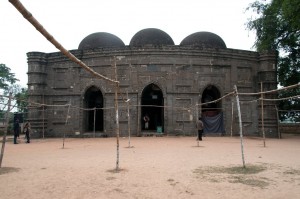
[post_content] => Kusumba Mosque is named after the village of Kusumba, under the Manda upazila of Naogaon district, on the west bank of the Atrai River. It is inside a walled enclosure with a monumental gateway that has standing spaces for guards. It was built during the period of Afghan rule in Bengal under one of the last Suri rulers Ghiyasuddin Bahadur Shah, by one Suleiman who was probably a high ranking official. The inscription tablet in Arabic (only the word ‘built by’ is in Persian) dating the building to 966 AH (1558-59 AD) is fixed over its eastern central entrance.
Although built during Suri rule, it is not influenced at all by the earlier Suri architecture of North India, and is well grounded in the Bengal style. The brick building, gently curved cornice, and the engaged octagonal corner towers are typical features. The mosque, presently protected by the Department of Archaeology of Bangladesh, was badly damaged during the earthquake of 1897. Although the main fabric of the building is of brick the entire exterior walls, and the interior up to the arches of the pendentives have stone facing. The columns, platform, floor, and perforated side screens are of stone. The mosque has a rectangular plan with three bays and two aisles, three entrances on the east and two each on the north and south sides.
The central mihrab is projected in the west. The interior west (qibla) wall has two mihrabs on the floor level opposite the central and southeastern entrances, but the one in the northwestern bay is above a raised platform ascended by a staircase on the east. The presence of such a platform in a non-imperial mosque indicates that not only royalty, but nobility and high-ranking officials were also separated from the general public during prayers. The mihrabs have elaborate stone carving. They have cusped arches crowned with kalasa (water pot) motifs, supported on intricately carved stone pillars which have projections and tasseled decorations hanging from chains. Bunches of grapes and vines curve in an almost serpentine manner on the mihrab frames, and kalasas, tendrils and rosettes are reduced to dots.
The platform edge has grape vine decoration, and there are rosettes on the spandrels of the arches supporting the platform, as well as on the mihrab wall. The stone used in the exterior facing is of a coarse quality and carved in shallow relief. Mouldings are most prominent decorative feature on the outside. They divide the walls into upper and lower sections, run all along the curved cornice, around the corner towers, in a straight line below the cornice, and frame the rectangular panels in the east, south and north walls. The spandrels of the central entrance arch are filled with small kalasa and rosette motifs. The north and south sides have screened windows.
)
)