Brief
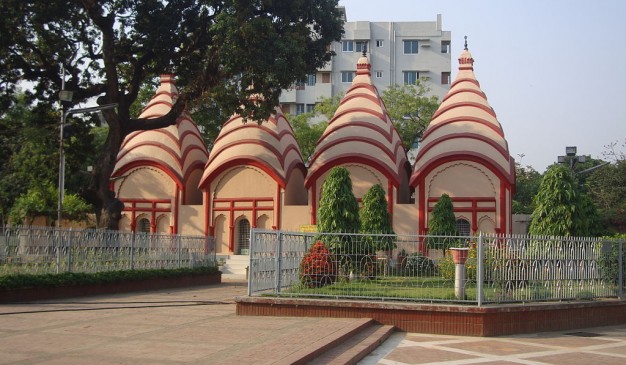
Dhakeshwari National Temple is a Hindu temple in Dhaka city. It is state-owned, giving it the distinction of being Bangladesh’s ‘National Temple’. The name “Dhakeshwari” means “Goddess of Dhaka”. Since the destruction of Ramna Kali Mandir in 1971 by the Pakistan Army during the Bangladesh Liberation War, the Dhakeshwari Temple has assumed status as the most important Hindu place of worship in Bangladesh.
The Dhakeshwari temple was built in the 12th century by Ballal Sen, a king of the Sena dynasty, and many say the city was named after this temple. The current architectural style of the temple cannot be dated to that period because of the numerous repairs, renovations and rebuilding which have taken place over time. It is considered an essential part of Dhaka’s cultural heritage. Many researchers said that the temple is also one of the Shakti Peethas, where the jewel from the crown of the Goddess Satihad fallen. Although there is not enough historical context to establish this as a fact, researchers were directed to this site while trying to locate the particular Shakti Peetha. Since ages, the temple has been held in great importance. The original 800-year old statue was taken to Kumartuli, Kolkata, West Bengal, India. There remains the replica of original idol in Dhaka. The temple was further damaged during the Muslim mob attacks of 1989–90.
It is widely believed that the Queen, wife of King Bijoy Sen, went to Langolbond for bathing. While coming back, she gave birth to a son, known to historians as Ballal Sen. After ascending to the throne, Ballal Sen built this temple to glorify his birthplace. Legends say that Ballal Sen once dreamt of the deity covered under the jungle. Ballal Sen uncovered the deity from there and built a temple, named for Dhakeswari. Whatever the legends describe, Hindu religious consider Dhakeswari to be the presiding deity of Dhaka, which is an incarnation or form of Goddess Durga the Adi Shakti . The idol of Durga is called Dhakeswari.
Within the premises of the Dhakeswari there are temples of two types of architecture. The ancient one is of the Poncharotna Goddess Durga’s which lost its actual look after the renovation work. Bradly Bird wrote this at the beginning of this century. The present temple is two hundred years old which was built by an agent of East India Company. Most probably he had renovated the temple. Other than this there are four Shib Temples. According to hearsay, in the 16th century King Mansing built these temples by laying four Shib Lingas there. But this information seems to be unreliable. The fusion of Bangla chowchala and shikor temple is notice in the architecture of Dhakeshawri. Ratan Lal Chakraborti in an article mentioned that “ the structure and architecture of it is like a BuddhistPagoda”. He opined that it was probably a Boddist pagoda which was turned into a Hindu temple later. From this, he assumed that the temple was probably built in the 10th century.
How did Dhakeshari temple look like in the 19th century? Ridoynath Majumder described about the temple. At that time the temple was covered by jungle and in its north the Urdu road went westward towards Pilkhana and at its south west was Mirpur road. At its south there was a wood and Urdu bazaar was at the east.
Where to Stay
There are more than 71 quality hotel in Dhaka. Some are listed below…
1. Pan Pacific Sonargaon Hotel, Dhaka
107 , Kazi Nazrul Islam Avenue
Dhaka, Bangladesh
Tel: +880 2 811 1005
Website : Pan Pacific Sonargaon Hotel, Dhaka
2. Ruposhi Bangla Hotel
1 Minto Road, Shahbagh, Dhaka,
Bangladesh.
Phone : 88-02-8330001
Fax : 88-02-8312975
Email : sales@ruposhibanglahotel.com
Website : Ruposhi Bangla Hotel
3. Radisson Water Garden Hotel, Dhaka
Airport Road, Dhaka Cantonment,
Dhaka 1206 Bangladesh.
Telephone: + 88 02 8754555
Fax: + 88 02 8754554 , + 88 02 8754504
Email : reservations.dhaka[at]radisson.com
Website : Radisson Water Garden Hotel
Dhaka Bangladesh
4. Dhaka Regency Hotel & Resort
Airport Road, Nikunja 2
Dhaka 1229, Bangladesh.
Phone : +88-02-8913912, +880 2 8900250-9
Fax : +88-02-8911479
Email : info@dhakaregency.com
Website : www.dhakaregency.com
5. Best Western La Vinci Hotel, Dhaka
54, Kawran Bazar,
Dhaka-1215, Bangladesh
Phone No : 880-2-9119352
Fax No : 880-2-9131218
E-mail : lavinci[at]bol-online.com ,
reservation[at]lavincihotel.com
Web : www.lavincihotel.com
6. The Westin Hotel
Main Gulshan Avenue,
Plot-01, Road 45, Gulshan-2
Dhaka-1212, Bangladesh
Phone : 88-02-9891988
7. Royal Park Residence Hotel
House no. 85, Road no. 25A
Block – A, Banani,
Dhaka 1213 Bangladesh.
Telephone: + 88 02 8815945/46
Fax: + 88 02 8815299
Email : hotelinfo[at]royalparkbd.com
Website : Royal Park Residence Hotel
8. Bengal Inn
House # 07, Road # 16,
Gulshan – 01
Dhaka 1212 Bangladesh.
Tel: +880 2 98880236, 9880610
Fax: +880 2 9880274
Email : info[at]bengalinn.com
Website : www.bengalinn.com
9. Hotel Sarina Dhaka
Plot #27, Road #17
Banani C/A,
Dhaka 1213 Bangladesh.
Tel: +880 2 8859604 -10, 8851040 -2, 8851011-4
Fax: +880 2 988-9989
Email : sales[at]sarinahotel.com, reservations[at]sarinahotel.com
Website : www.sarinahotel.com
Array
(
[0] => Array
(
[name] => Ashram of Loknath Baba
[post_id] => 22280
[post_link] => http://offroadbangladesh.com/places/ashram-of-loknath-baba/
[thumb_link] => http://offroadbangladesh.com/wp-content/uploads/2015/10/P_20151013_204336_1_p-300x169.jpg
[post_content] => Ashram of Loknath Baba is a holy place for Bengali Hindu pilgrimages and religious people in Mymensingh. Everywhere in our country a pilgrim from Hindu religion will find a Ashram devoted for the worshiping. In Mymensingh city ORB team experienced couple of Ashrams on the edge and nearby Brahmaputra river. All around the year people worship here but in the month of June of every year this Mymensingh Loknath Babar Ashram becomes more festive at the event of Tirodhan Dibos (on Tithi) of Baba Loknath.
Great quotation of Baba Loknath to his devotees: “Whenever you are in danger, whether in war, forest, ocean or jungle, remember me. I shall save you.”
Baba Loknath was born on 31 August 1730 (Bengali calendar 18th Bhadra, 1137) on the sacred day of Krishna Janmashtami in in the village of Chaurasi Chakla, named as Kochua, few miles far from Kolkata, North 24 Parganas, now in West Bengal, India. He is from a Brahmin family. His father name was Sri Ramnarayan Ghoshal and mother name was Shrimatee Kamaladevi. He has lot of followers and devotees around the world. He has traveled many pilgrimages on foot of Persia, Arabia, Israel and Mecca. They believe at the age of 160, on June 1, 1890 C.E. Baba Loknath took his Samadhi (Left his life means died). There is only one photograph is available at present of Baba.
)
[1] => Array
(
[name] => Motter Moth
[post_id] => 14403
[post_link] => http://offroadbangladesh.com/places/motter-moth/
[thumb_link] => http://offroadbangladesh.com/wp-content/uploads/2015/08/IMG_20150805_134634250_HDR-300x169.jpg
[post_content] =>
Temple of Motto or Motter Moth (মত্তের মঠ) is located at the village Motto (মত্ত) of Manikganj Sadar Upazila. It is situated at the eastern side of Manikganj (মানিকগঞ্জ) town.
This Moth is about 50-60 feet tall, looks like a Shiva temple. Currently this Moth is abandoned, located beside a pond. A new temple is built near the old one. It is not sure who built that moth or its actual time period.
People says that a prominent Zamindar Ram Krishna Sen (জমিদার রামকৃষ্ণ সেন) lived at Motto Village. Possibly he could built this temple. From the close observation, it is assumed that this Moth could be around 100 years of old, or may be less.
)
[2] => Array
(
[name] => Sonarong Jora Moth
[post_id] => 8450
[post_link] => http://offroadbangladesh.com/places/sonarong-jora-moth/
[thumb_link] => http://offroadbangladesh.com/wp-content/uploads/2015/05/SJM-1-300x240.jpg
[post_content] =>
Sonarong (means golden color) is a lovely village at Tongibari Upazila of Munshiganj district. This village belong a beautiful "Moth(মঠ)"(a place for praying by Hindu religious people) which is known as "Sonarong Jora Moth" (সোনারং জোড়া মঠ) ("twin moth"). It is used to call twin moth/temple, because it has two towers side by side. It may be around 150 feet high from the ground. There is a large pond just in front of the Moth. This moth is not functioning now a days. Interviewing local people we came to know that, there are no praying activities take place in this moth. Every side of the moth is covered with trees and that gave a lovely golden and green color's illusional view of the moth.
The larger moth was made for "Shiva"(Hindu God), and made during 1843, and the smaller one for "Kali"(Hindu Goddess), and made during 1886. It was built by a Hindu merchant named "Rupchand" (রূপচাঁদ) From stone inscriptions fixed over the temple’s entrance.
The two towers of the moth are not equal sized. One is much larger than another one. The larger tower has hundreds of holes at the top of it, and each hole is occupied by parrots. Visitors may observe hundreds of parrots from the place, and they are making sweet sound together all the day long. During the breeding season, the top of the moth become green for the numerous numbers of parrots. Both the towers of the moth are ornamented nicely with different types of leafs motif and blind alcoves.
Architectural Features:
Two temples stand side by side on a single masonry platform surrounded by a moat on three sides and an access path on the eastern side.The western temple, loftier than the eastern one, is about 15m high over the square sanctum, and measures 5.35m x 5.35m and has a 1.90m wide veranda. A low hemispherical dome covers the square sanctuary, over which rises an octagonal sikhara(শিখর) crowned by the usual pinnacle with kalasa (কলস) finials. This terminates in a trident fixed with an iron rod. The outer surface of the sikhara is decorated with a semi-circular arched pattern in plaster, which is repeated on all sides. The entire sikhara is dotted with three pigeonholes under each arch pattern. The main sanctuary has two archways, one each on the south and west sides, flanked by arched panels on both sides,and a pattern of three arches on the other two sides. The western entrance consists of a two-centered arch. The top of the archway is decorated with a frieze of blind merlons. In front of the sanctum, the veranda is covered with a flat roof supported on columns, It has three arched openings on the south, one each on its east and west side.
It is one of the important historical & archaeological places in Munshiganj District. Very recently,renovation work is on go,undoubtedly a good initiative to protect this site from further destruction.
)
[3] => Array
(
[name] => {:en}Puthia Temple{:}{:bn}পুঠিয়া মন্দির{:}
[post_id] => 3008
[post_link] => http://offroadbangladesh.com/places/puthia-temple/
[thumb_link] => http://offroadbangladesh.com/wp-content/uploads/2015/02/puthia-temple21-300x225.jpg
[post_content] => {:en}
Puthia Temple Complex consists of a cluster of notable old Hindu temples in Puthia Upazila, Rajshahi Division, Bangladesh. Located 23 km to the east of Rajshahi city, it has the largest number of historic temples in Bangladesh. The temples were built by Hindu Zamindars Rajas of the Puthia Raj family who were noted philanthropists of Rajshahi. The temples have been built in terracotta in a variety of styles combining the typical Jor-bangla architecture with other influences. The Rajbari or Palace of the Raja of Puthia and the Dol Mancha are part of the complex. The temples are laid out around a lake with a sprawling lawn.
The Puthia Raj family was established by a holy man named Bhatsacharya, who lived in the 16th century. Raja Man Singh, governor of the Mughal emperor Akbar, confiscated the Jagir of the refractory pathan jagirdar of Rajshahi named Lashker Khan and bestowed the Zamindary on the saintly Bhatsacharya for his learning, but he declined. However, his son Pitambar was granted the Lashkarpur estate permanently. On his death, his son Nilambar received the title of Raja from Emperor Jahangir. The Puthia Royal Family estate was the second largest zamindary and the wealthiest in British Bengal. After India's partition, the then Pakistani government abolished the zamindary system and confiscated all Hindu properties. The Royal Family migrated to India shortly afterwards.
{:}{:bn}
এখানে বেশকিছু প্রাচীন হিন্দু মন্দির আছে। হিন্দু জমিদার রাজারা এবং পুঠিয়া পরিবার মন্দিরগুলো নির্মাণে সম্পৃক্ত ছিল। তেরাকোটায় নির্মিত মন্দিরটিতে বিভিন্ন প্রাণী ও অন্যান্য স্থাপত্য খোদাই করা আছে। মন্দির কমপ্লেক্সে আছে রাজবাড়ি এবং দলমাছা। এছাড়াও এখানে একটি লেক ও বাগান আছে। এছাড়াও এখানে আছেঃ
পঞ্চরত গোবিন্দ মন্দিরঃ ঈশ্বর কৃষ্ণর প্রতি উৎসর্গ করা আঠারোশ শতাব্দীতে নির্মিত পুঠিয়ার একটি মন্দির এটি।
ভুবেনেশ্বর শিব মন্দিরঃ রানি ভবানি এই মন্দিরটি নির্মাণ করেন ১৮২৩ সালে যেটি শিব মন্দিরগুলোর মধ্যে সর্বশ্রেষ্ঠ।
জগন্নাথ মন্দিরঃ হিন্দু ধর্মের ঈশ্বর জগন্নাথের প্রতি উৎসর্গ করা মন্দির এটি।{:}
)
)