Array
(
[0] => Array
(
[name] => Deo Bari
[post_id] => 8713
[post_link] => http://offroadbangladesh.com/places/dao-bari/
[thumb_link] => http://offroadbangladesh.com/wp-content/uploads/2015/05/Dao-Bari-11-300x200.jpg
[post_content] =>
There is a significant number of old houses found in Munshiganj district. Which has enriched the historical & Cultural importance of this district among the others in Bangladesh. It’s assumed that in earlier phase it was a prominent center for trading all over the country as it is standing beside the mighty river Meghna. So, historically still this place contains the plenty of evidences of growing business trend at that time.
One of the most old houses built by the Merchant is Deo Bari ( দেউ বাড়ি) at Abdullahpur, Tongibari, Munshiganj. It’s about 120 Years Old Historical House (Adjacent to Pulghata Bridge). Shokti de (শাক্তি দে) and Vokto de (ভক্ত দে) built this 3 storied building. Still 45 rooms found in this derelict building.
The most fascinating part of this house is its brick-work with some fabulous design & decoration. which has become exposed now that the plasters have fallen off at many places.
This building is now on the way of decaying. Many parts of its has already broken because of lack in proper care and conservation. Immediate steps should be taken to preserve it from further destruction.
)
[1] => Array
(
[name] => Tushbhandar Zamindar Bari or Landlord House
[post_id] => 4790
[post_link] => http://offroadbangladesh.com/places/tushbhandar-zamindar-bari-or-landlord-house/
[thumb_link] => http://offroadbangladesh.com/wp-content/uploads/2015/03/Tushabhandar-jamindar-bari1-300x212.jpg
[post_content] =>
During the period of Maharaja Pran Narayan "Rsik Ray bigroho" happened in 1634 and in that time the origin of tushvandar Murari dev Ghosal Vottacharjo from 24 porgona/Kolkata's Jay nagar came in Koach bihar and in upuonchouki matter get a taluk anstarted to live here. During that time to do religious work land was given by upenchouki matter. Murari dev disagree to take the donation of the shudro king's beacuse he is a brammon. He appealed to take rent for the land. After that the queen agreed to take paddy bran as rent. Dew to give rent as paddy bran it was stored near landlord house in the east side and after it was sent to the Koachbihar kings house. With this bran many religious events happened in the king’s house. People says that, for the stored bran this place was named as tushvandar. By brammahan murari dev vottacharja the landlord of tushvandar was declared. And in 1935 with his death as long 400 years land owner was came into an end.
)
[2] => Array
(
[name] => {:en}Chondro Mohol{:}{:bn}চন্দ্রমহল{:}
[post_id] => 6479
[post_link] => http://offroadbangladesh.com/places/chondro-mohol/
[thumb_link] => http://offroadbangladesh.com/wp-content/uploads/2015/04/Chondro-Mohol-Bagerhat-031-300x214.jpg
[post_content] => {:en}
There is a picnic spot located at the village near Ronojitpur (রণজিতপুর). It is based on a house named Chondro Mohol. It was probably built by someone named Saiyad Amanul Huda Selim, who was a naval officer. Chondra (চন্দ্রা) is the name of his wife and the name of the house is given after her. Lot of local visitors use to come here every day. It was free once upon a time, but now a days they have put an entry fee to enter. Its 20 Taka these days. Apart from the house, the area is nicely decorated with flowers. Also it has symbolic sculptures to depict the lost culture of our Bangladesh. It has a mini zoo at one corner, and has several ponds around.
The house Chondro Mohol (চন্দ্র মহল) is surrounded by water and to reach there you have to go through an underpass that goes under the water. Inside the house, they have placed few stuffs which probably are the collected things from several part of the world (as a hobby, or during their traveling).
{:}{:bn}
চন্দ্রমহল নামে একটি ভবনকে কেন্দ্র করে রঞ্জিতপুরের কাছে একটি পিকনিক স্পট রয়েছে। সম্ভবত সৈয়দ আমানুল হুদা সেলিম নামক এক ব্যাক্তি এই ভবনটি নির্মাণ করেন এবং তাঁর স্ত্রী চন্দ্রের নামে ভবনটির নামকরণ করেন। তিনি ছিলেন নৌ বাহিনীর একজন কর্মকর্তা। প্রতিদিন অসংখ্য স্থানীয় পর্যটক এখানে আসেন। পূর্বে এখানে ঢুকতে কোন প্রবেশ মূল্য না দিতে হলেও বর্তমানে ২০/- টাকা প্রবেশ মূল্য দিয়ে প্রবেশ করতে হয়। চন্দ্র মহল ছাড়াও পুরো এলাকাটি ফুল দিয়ে চমৎকারভাবে সাজানো হয়েছে। এদেশের হারিয়ে যাওয়া সংস্কৃতিকে এখানে ভাস্কর্যের মাধ্যমে তুলে ধরা হয়েছে। একটি মিনি চিড়িয়াখানা ছাড়াও এখানে বেশ কয়েকটি পুকুরও আছে।
পানি উপর স্থাপিত চন্দ্রমহলে আপনাকে পানির নীচে নির্মিত একটি আন্ডারপাস দিয়ে আসতে হবে। ভবনটির অভ্যন্তরে পৃথিবীর বিভিন্ন অংশে বেড়ানোর সময় সেখান থেকে শখের বশে সংগ্রহ করা বিভিন্ন জিনিসপত্র প্রদর্শিত হচ্ছে।
{:}
)
[3] => Array
(
[name] => Kusumba Mosque
[post_id] => 3656
[post_link] => http://offroadbangladesh.com/places/kusumba-mosque/
[thumb_link] => http://offroadbangladesh.com/wp-content/uploads/2015/02/84463426-300x199.jpg
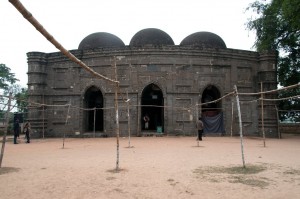
[post_content] => Kusumba Mosque is named after the village of Kusumba, under the Manda upazila of Naogaon district, on the west bank of the Atrai River. It is inside a walled enclosure with a monumental gateway that has standing spaces for guards. It was built during the period of Afghan rule in Bengal under one of the last Suri rulers Ghiyasuddin Bahadur Shah, by one Suleiman who was probably a high ranking official. The inscription tablet in Arabic (only the word ‘built by’ is in Persian) dating the building to 966 AH (1558-59 AD) is fixed over its eastern central entrance.
Although built during Suri rule, it is not influenced at all by the earlier Suri architecture of North India, and is well grounded in the Bengal style. The brick building, gently curved cornice, and the engaged octagonal corner towers are typical features. The mosque, presently protected by the Department of Archaeology of Bangladesh, was badly damaged during the earthquake of 1897. Although the main fabric of the building is of brick the entire exterior walls, and the interior up to the arches of the pendentives have stone facing. The columns, platform, floor, and perforated side screens are of stone. The mosque has a rectangular plan with three bays and two aisles, three entrances on the east and two each on the north and south sides.
The central mihrab is projected in the west. The interior west (qibla) wall has two mihrabs on the floor level opposite the central and southeastern entrances, but the one in the northwestern bay is above a raised platform ascended by a staircase on the east. The presence of such a platform in a non-imperial mosque indicates that not only royalty, but nobility and high-ranking officials were also separated from the general public during prayers. The mihrabs have elaborate stone carving. They have cusped arches crowned with kalasa (water pot) motifs, supported on intricately carved stone pillars which have projections and tasseled decorations hanging from chains. Bunches of grapes and vines curve in an almost serpentine manner on the mihrab frames, and kalasas, tendrils and rosettes are reduced to dots.
The platform edge has grape vine decoration, and there are rosettes on the spandrels of the arches supporting the platform, as well as on the mihrab wall. The stone used in the exterior facing is of a coarse quality and carved in shallow relief. Mouldings are most prominent decorative feature on the outside. They divide the walls into upper and lower sections, run all along the curved cornice, around the corner towers, in a straight line below the cornice, and frame the rectangular panels in the east, south and north walls. The spandrels of the central entrance arch are filled with small kalasa and rosette motifs. The north and south sides have screened windows.
)
)