Array
(
[0] => Array
(
[name] => Tajhat Zamindar Palace
[post_id] => 1923
[post_link] => http://offroadbangladesh.com/places/tajhat-zamindar-palace/
[thumb_link] => http://offroadbangladesh.com/wp-content/uploads/2015/02/IMG_50442-300x225.jpg
[post_content] =>
Few of the attractions in Bangladesh are as stately, large and beautiful as the Tajhat Zamindar Palace. This historical palace was built near the beginning of the 20th century. It is situated roughly three kilometers south east of Rangpur’s city center and currently serves as a museum for the public.
The front of this impressive edifice is about 76 meters long and two stories high. A ribbed conical dome supported by a tall octagonal neck is located in the center of the roof and crowns the palace. These are just some of the extraordinary features that continue to attract visitors from around the world to this small corner of the globe. The incredible architectural skill that went into the building and design of this 100-year-old palace is truly something special and visitors often find themselves stunned by the craftsmanship that is found in this amazing structure. It is hard to believe that all this, and the surrounding city, all started as a simple bit of trade involving hats.
Sometime during the 18th century a man by the name of Manna Lal Roy traveled from Punjab in India as a cap or hat merchant.There was a massive cap bazaar where trade was regularly conducted about half a kilometer southwest of Mahiganj and this was where he set up shop. The area was known appropriately as taj (cap) hat (bazaar) and the name has always stuck. Manna Lal Roy was a shrewd businessman who managed to amass quite a bit of wealth through his cap sales. In fact he became so rich that he was able to loan many of the viceroys in the region money during the famine of 1770-1790. This gave him immense power and influence and eventually led to him becoming the founder of the Tajhat dynasty. In the 1900s, one of his indirect heirs, GobindaLal Roy, became the last viceroy and Raja of Tajhat. GobindaLal Roy was the most educated viceroy to ever take his position and under his authority Tajhat flourished. It is thought that the Tajhat Palace was built under his rule.
There are a number of features of the palace that testify to the incredible wealth of the Lal Roy viceroy. Apart from the building’s immense size, the wide stairs that climb to the second story on the front of the building are made of marble. Beautiful pictures can be found on doors and windows.
)
[1] => Array
(
[name] => {:en}Nirmai Shibbari{:}{:bn}নির্মাই শিববাড়ি{:}
[post_id] => 6393
[post_link] => http://offroadbangladesh.com/places/nirmai-shibbari/
[thumb_link] => http://offroadbangladesh.com/wp-content/uploads/2015/02/offroadbangladeshlogo2-300x178.png
[post_content] => {:en}
Nirmai Shibbari was built nearly 500 years ago. Many believe that there were Kuki tribes in this area. The Kuki government frequently did not obey the command of the ruling Tripura government. For controlling mutineers, the King of Tripura sent a group of troops. King’s son led the battle. The Tripura King won the battle but lost his son in law.
{:}{:bn}নির্মাই শিববাড়ি মৌলভীবাজার জেলার শ্রীমঙ্গল উপজেলায় অবস্থিত। এই শিববাড়িটি প্রায় পাঁচশত বছর পূর্বে নির্মাণ করা হয়। অনেকেই বিশ্বাস করেন একসময় এখানে কুকি সম্প্রদায়ের মানুষজন বসবাস করত। কুকিরা তৎকালীন শাসক ত্রিপুরা সরকারের নির্দেশ মেনে চলত না। কুকিদের নিয়ন্ত্রনের জন্য ত্রিপুরার রাজা তাঁর পুত্রের নেতৃত্বে এখানে সেনাদল পাঠিয়েছিল। পরবর্তী সময়ে সংঘটিত যুদ্ধে ত্রিপুরার সেনাদল জয়ী হলেও সেই যুদ্ধে ত্রিপুরার রাজা তাঁর পুত্রকে হারান।{:}
)
[2] => Array
(
[name] => Nagar Kasba
[post_id] => 8573
[post_link] => http://offroadbangladesh.com/places/nagar-kasba/
[thumb_link] => http://offroadbangladesh.com/wp-content/uploads/2015/05/Nogor-Kosba-2-300x169.jpg
[post_content] => Kasba (কসবা) is an administrative unit of the Sultani rulers (1342-1576). The administrative units, such as Iqta(ইকতা), Erta (ইরতা), Iqlim (ইখলিম), and Kasba (কসবা) have been mentioned in the contemporary texts.
So far 37 Kasbas could be traced in the region of Bangladesh, most of which had been within or near about the present district towns. The distance between one Kasba from another varied. It is noticed that official titles were associated with some of the kasbas. We can exemplify Kazir Kasba (কাজীর কসবা), Kotowaler Kasba(কোতওয়ালির কসবা), Nagar Kasba(নগর কসবা) etc. Considering the location, distance of one from another, communication system with the central or Provincial Capital, attachment of official titles etc it is assumed that Kasba were administrative units and were equivalent to districts. An administrative officer, a Quazi (কাজী) and a Kotwal(কোতওয়াল) were in charge of a Kasba.
In this complex of many buildings we can detect several names of businessman who built those in different period of time in 19th Century.
While most of the Kasbas lost their former importance during the Mughal period, Munshiganj, or Bikrampur, as it was known earlier, flourished as an important district through a rich combination of education, economy, literary & cultural pursuits. Therefore, the Nagar Kasba of Munshiganj stood with its importance through the course of time. It is believed that during the British rule, especially during the later part of the 19th century, Nagar Kasba was rebuilt as a residential area of wealthy predominantly Hindu business people, who mostly traded through the river port of Mirkadim.
After the Partition of India (1947), it is believed that most of the Hindu wealthy families migrated to Kolkata. Those who decided to stay back, to tend to their established businesses soon began to find it difficult. As sporadic communal riots continued, the exodus continued till the late 1950s. Families often left silently at night, leaving behind all their belongings. Those who still chose to stay, almost completely left for India during our Liberation War in 1971.
During these dire times, most of these full-furnished wealthy houses fell vacant and remained untended for a long time. Gradually, over time, these empty houses began to be taken over by influential locals. The descendents of these grabbers now own these properties, and live in the dilapidated buildings. It therefore is not surprising that a house that looks like it was purposely built for Hindu owners now adorns the names of Muslim people.
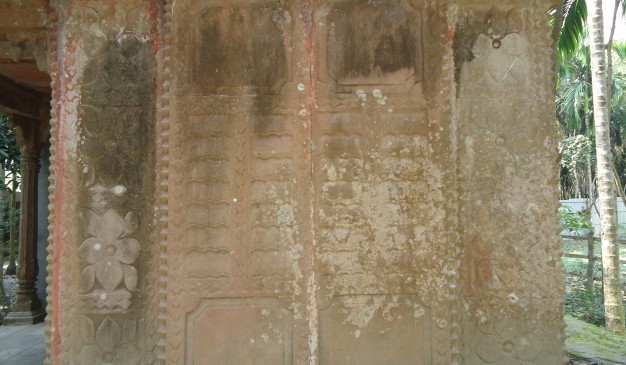
Even in its latest hay days in the later part of the 19th century, Nagar Kasba was a row of magnificent houses, mostly of two floors, though not too large, but built in British colonial styles. The intricate designs and motifs that remain on the walls and pillars are testament to the wealth and taste of the owners. Unfortunately, almost all are now in ruins, where some have even been demolished by present day owners.
)
[3] => Array
(
[name] => House of Jogunath Roy
[post_id] => 9551
[post_link] => http://offroadbangladesh.com/places/house-of-jogunath-roy/
[thumb_link] => http://offroadbangladesh.com/wp-content/uploads/2015/07/Jogunath-Roy-1-169x300.jpg
[post_content] =>
House of Jogunath Roy is located in Sreenagar Upazila of Munshiganj District. Jogunath Roy was intended to live here even after the Liberation War in 1971, but the social condition did not permit him to stay in his motherland. He was then migrated in India.
[We need more detail information of this spot. If you have more information and photos, please be advised to add and share in our website. Your name will be published as a Content Contributor]
)
)