Brief
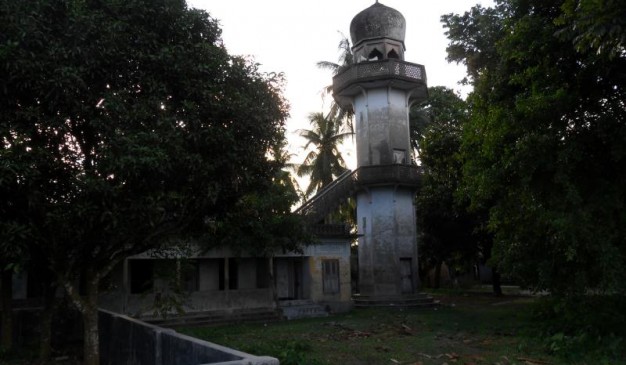
Arpara Munshi Bari (আড়পাড়া মুন্সীবাড়ী) is located near at Arpara (আড়পাড়া) of Gopalganj district. This is situated beside a man-made straight canal named ‘Beel Route Canal‘. This is mainly a two stored building and not that much older. But due to lack of care (and also the owner shifted to new place) it is a haunted house now a days.
The windows of this house are missing, doors are gone; trees have grown over this building and started covering it. You can hear lot of chirping sounds of birds; but it is actually a hideout for the bats. Thousands of bats you can see hanging upside down from the roof, and lot of them are flying randomly around and making the noise. It looked slight scary, but an amazing thing to watch.
Probably it’s around 50-60 years of old building and built by a rich family having family/surname Minshi (মুন্সী). They are still powerful, and prominent there by status and wealth. There are few other buildings available near this one and people are living there. Possibly they have shifted from here.
How to go
This Arpara Munshi Bari is located at Arpara village which is slight far from the main Gopalganj town. We have gone there through the Nimtoli Mor (23° 2’5.37″N, 89°48’24.12″E) and returned back through another way. It will be better if you visit this place using the path that one we have used for exit. Here we go:
1) Get down from the bus at the place near Arpara on the Dhaka-Gopalganj or Tekerghat-Gopalganj highway. GPS coordinate of the dropping point is (23° 3’3.16″N, 89°49’1.04″E).
2) Cross the river (actually it’s a canal) using the boat. Its 2 taka per person. But the boatman is a handicap guy and if you pay him more, it will be helpful for him.
3) Arpara Munshi Bari is just at the other side of the canal, and GPS coordinate of the house is (23° 3’3.13″N, 89°48’50.81″E).
How To Reach: Gopalganj District
Gopalganj district is located 140 km away from Dhaka via Mawa Ferry Ghat.
1. Modhumoti Paribahan
Gopalganj to Saydabad/Gulistan via Mawa Ferry Ghat
Mobile: 01716019937 (Gopalganj)
01711900619 (Dhaka)
2. Tungipara Express
Gopalganj to Saydabad/Gulistan via Mawa Ferry Ghat
Mobile: 01716479631 (Gopalganj)
01716211642 (Dhaka)
3. dola Paribahan
Gopalganj to Saydabad/Gulistan via Mawa Ferry Ghat
mobile: 01711311756 (Gopalganj)
01199030181 (Dhaka)
4. Comfort Line
Gopalganj to Saydabad/Gulistan via Paturia Ferry Ghat
Mobile: 01716453061
Where to Stay
1. Circuit House, Gopalganj
Contact to: Nejarot ( নেজারত ) Deputy Collector
Phone: 02-6685234 & 02-6685565
2. Zilla Parishad Cottage, Gopalganj
Contact to: Chief Executive Officer, Zila Parishad
Phone: 0668-61204
3. Hotel Modhumoti, Tungipara, Gopalganj
Contact to: Mr. Sheikh Ahmed Hossain Mirza
Phone: 02-6656349
Mobile: 01712-563227
4. Hotel Rana, Chourangi, Gopalganj
Contact to: Mr. Siraj Uddin Ahmed
Phone: 02-6685172
5. Hotel Shohag, Post Office Road, Gopalganj
Contact to: Mr. Shohrab Hossain
Phone: 0668-61740
Array
(
[0] => Array
(
[name] => Kakina Zamindar Bari
[post_id] => 4781
[post_link] => http://offroadbangladesh.com/places/kakina-zamindar-bari/
[thumb_link] => http://offroadbangladesh.com/wp-content/uploads/2015/03/kakina-Zamindar-Bari-1-300x216.jpg
[post_content] =>
Kakina Zamindar Bari is situated about 30 km distance from Lalmonirhat district in Kakina Union at Kakina moujai. Maharaja Mod Narayan's time Kakina was a Chakla of kocabihar. Indra Narayana Chakraborty was then the cakaladara of kakina. In 1687 the Fouzdar Ebadat khan declared war against King Mod Narayan and went to koachbihar and that time two sons of Raghu Ram Raghabendo Narayan and Ram Narayan took the support of the Fouzdar. After being filed in this war of Moghals Endra Narayan was removed from the post of Chakladar and Raghabendra Narayan was elected for Porgona 62 and Ram Narayan was elected for Kakina. As this the Chakladari of Indra Narayan Chakrawarti was finished. In 1687 that estate started in time of Ram Narayan finished in the period of Mahendra Ranjon for his unforeseen costs. When he failed to back the revenue of government his estate was sold in auction in 1925 and go under court of words. After that he left Kakina as a destitute state. He breathe last in Karsiang. For image, Click here
)
[1] => Array
(
[name] => Chakma Rajbari
[post_id] => 756
[post_link] => http://offroadbangladesh.com/places/chakma-rajbari/
[thumb_link] => http://offroadbangladesh.com/wp-content/uploads/2014/12/Chakma-Rajbari-Rajib-Bangladesh-1-300x169.jpg
[post_content] =>
Chakma Rajbari is one of the most beautiful Rajbari, which is located in Rangamati. This Rajbari was constructed by Raja Tridiv Roy, father of Raja Devasish Roy in 1960 when the earlier palace went under water due to commissioning of Kaptai dam. It has been learnt that Raja Devasish Roy is in Thailand. Every year number of visitors are come here to see this beautiful House. Chakma Rajbari is one of the major visiting attractions in Rangamati. This royal house represents the tradition and culture of Chakma (চাকমা).
[embed]https://www.youtube.com/watch?v=RrCHfXy_if0[/embed]
)
[2] => Array
(
[name] => Tahkhana Complex
[post_id] => 3614
[post_link] => http://offroadbangladesh.com/places/tahkhana-complex/
[thumb_link] => http://offroadbangladesh.com/wp-content/uploads/2015/02/Tahkhana-Complex42-300x225.jpg
[post_content] => Tahkhana Complex is located on the bank of a pond called Zahedulbala at a distance of 500m. towards north-west of Chhoto Sona Mosque. Two-storeyed in plan, the building called Tahkhana measures 35.35 x 11.58 m. On its first floor, there are 17 rooms of which two are octagonal. The octagonal room on the north-west was used for performing Salah, while the rest for different purposes, viz-saloon, recreation, dining, meeting hammam etc. The hammam complex proper is located on the south if the Tahkhana. There is a staircase in the south-east corner which leads down to the water level of the pond. There were provisions of supplying both cold and hot water following a channel of terracotta pipe, to the hammam complex. The entire building was constructed with small bricks laid in lime mortar. The wall of the building is decorated with niches and different kind of art motifs at its different points.
There are two views regarding the construction of this building. Firstly, Shah Shuja used to come and stay here for his administrative visit, rest and recreational purpose and to meet his spiritual guide Shah Niamatullah (R). Secondly, to provide residential accommodation to Shah Niamatullah (R) during the year 1655 AD. A mosque and tomb of Shah Niamatullah (R) are located on the north-west and north of the building respectively. At present, these buildings are protected monuments by the Department of Archaeology.
)
[3] => Array
(
[name] => {:en}Soigaon Zamindar Bari{:}{:bn}ছয়গাঁও জমিদারবাড়ি{:}
[post_id] => 6404
[post_link] => http://offroadbangladesh.com/places/soigau-jomider-bari-%e0%a6%9b%e0%a7%9f%e0%a6%97%e0%a6%be%e0%a6%81%e0%a6%93-%e0%a6%9c%e0%a6%ae%e0%a6%bf%e0%a6%a6%e0%a6%be%e0%a6%b0-%e0%a6%ac%e0%a6%be%e0%a7%9c%e0%a7%80/
[thumb_link] => http://offroadbangladesh.com/wp-content/uploads/2015/04/Soigau-Jomider-Bari-11-300x210.jpg
[post_content] => {:en}
Soigaon is the famous place in Shariatpur. Soigaon Zamindar Bari stands at Soigaon Union in Bhedarganj Upazila. In the time of ‘British Ruling' there was some famous leader who took part in the Independent War of India. In the time of 1930-1934 there was some British Camp.
[This spot needs more detail. If you have more information and photos, please be advised to add in our website. Your name will be published as a Content Contributor]
{:}{:bn}
শরীয়তপুরের একটি নামকরা স্থান হল ছয়গাঁও। ভারতের স্বাধীনতা আন্দোলনে অংশ নেওয়া কয়েকজন প্রখ্যাত নেতা এখানে বাস করতেন। এছাড়া ১৯৩০ সাল থেকে ১৯৩৪ সাল পর্যন্ত এখানে ইংরেজ সেনাদের ঘাঁটি ছিল। এখানে আসতে হলে আপনাকে প্রথম শরীয়তপুর জেলায় পৌছাতে হবে। সেখান থেকে ভেদরগঞ্জ উপজেলার ছয়গাঁও ইউনিয়নে পৌছাতে হবে।
{:}
)
)